
Difference between Occurrences and Instances
Occurrences are unique, while instances are not. When you put an attribute (such as a stop point) on an instance, it can apply to more than one object because instances cannot be identified uniquely. An instance is identified by the cell it is contained in. If the cell is used in multiple places in the design, the instance is in multiple places in the design.
An occurrence, on the other hand, is identified uniquely by its full path from the top-level design. When you put an attribute (such as a stop point) on an occurrence, it only applies to that single object.
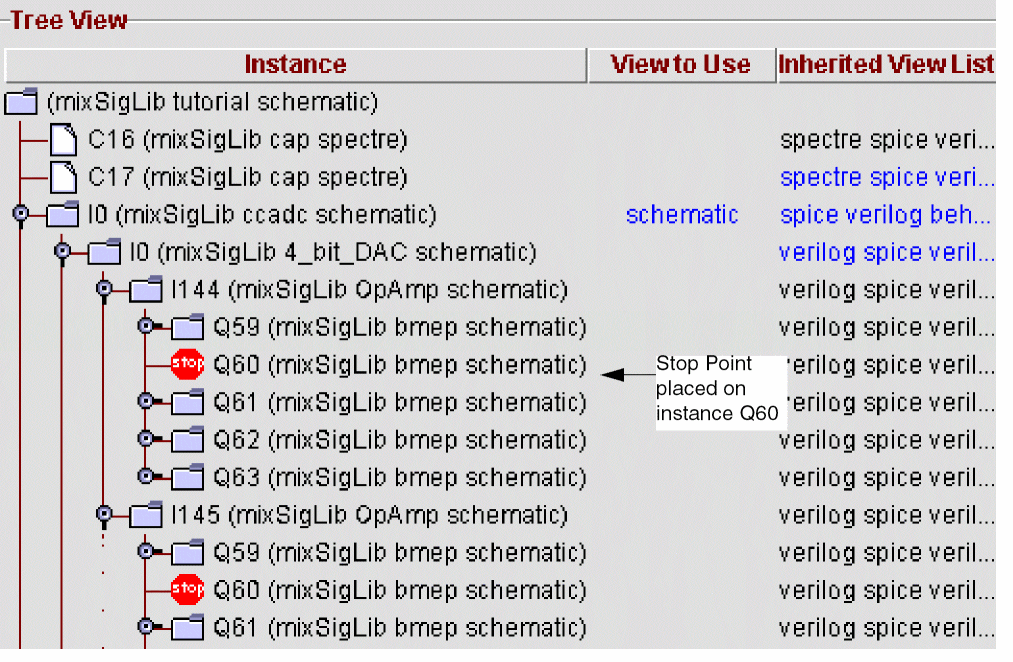
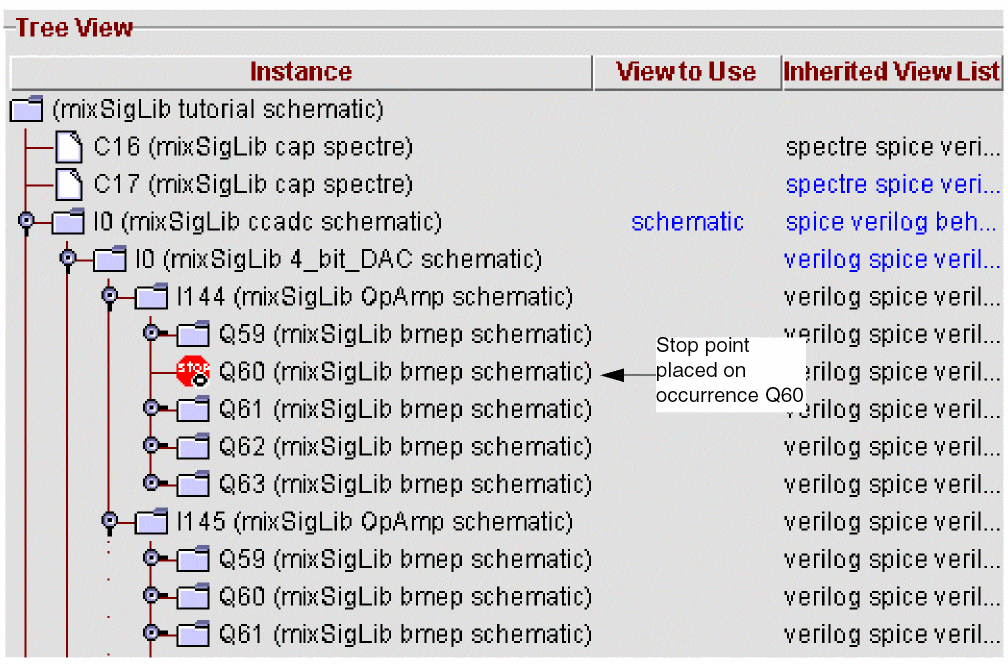
The following example illustrates the difference between instances and occurrences. Both Figure 1 and Figure 2 display the design mixSigLib.tutorial:schematic. In this design, the cell OpAmp is used twice—its instantiations are mixSigLib.tutorial:schematic.I0.I0.I144 and mixSigLib.tutorial:schematic.I0.I0.I145. The cell OpAmp contains several instances, including Q60.
In Figure 1, an instance stop point is specified on Q60 in I144. Notice that Q60 in I145 (the other instantiation of cell OpAmp) automatically gets the stop point, too.
In Figure 2, an occurrence stop point is specified on Q60 in I144. Notice that Q60 in I145 (the other instantiation of cell OpAmp) is not affected by the stop point. This is because the stop point was put on the occurrence and not on the instance.
Related Topics
Rules Definition at the Occurrence Level
Defining Occurrence Stop Points
Defining Occurrence-Level Bind-to-Open
Return to top