
1
Introduction
Simulation Basics
Fundamentally, SpectreRF provides large-signal and small-signal analyses. Large-signal analyses PSS, QPSS, HB, and Envelope solve all the equations, and capture all the harmonics that are produced by the system. Large-signal effects like compression are taken into account. Because all the nonlinearities of the system need to be solved for, the simulation time is longer than the simulation time for small-signal analyses where the large-signal effects like compression are not solved for. The nonlinearity solved for in the large-signal analysis is taken into account, so frequency translation effects caused by large signals are present in the small-signal analyses. Therefore, conversion gain and noise are accurate for systems that translate frequencies.
Fundamentals of RF Simulation
SpectreRF provides solutions for single or multi tone periodic systems using periodic steady-state (PSS) or quasi-periodic steady state (QPSS), and the small-signal analyses provided for all three. Noise simulations that include frequency translation are provided using Pnoise, hbnoise, or QPnoise. To measure small-signal conversion gain, pac, QPAC, pxf, and QPXF analyses are provided. To measure IP3, rapid IP3 is provided. To measure power gain, PSP and QPSP are provided. This is an extension of S-Parameters for systems that translate frequency. Non-periodic systems can be simulated using envelope.
Shooting Newton and Harmonic Balance algorithm
SpectreRF provides a choice of simulation engines between the traditional Shooting Newton method (or simply, Shooting method) and the Harmonic Balance method (HB) with most analyses. The Harmonic Balance engine complements the capabilities of the Shooting method.
The combination of a PSS or QPSS analysis using the Shooting method with a time-varying small-signal analyses is efficient for circuits that respond in a strongly nonlinear manner to the LO or the clock. Consequently, you can use the SpectreRF simulations with the Shooting method to simulate strongly nonlinear circuits, such as switched-capacitor filters, switching mixers, chopper-stabilized amplifiers, PLL-based frequency multipliers, and sample-and-holds. You can use the SpectreRF simulations with the Harmonic Balance method to simulate circuits that produce a reasonably small number of harmonics, such as Low-Noise Amplifiers (LNAs) or Gilbert cell mixers.
Generally, PSS is used for circuits with a single input frequency. Either Shooting or Harmonic Balance can be used. Usually QPSS or HB is used for circuits that have more than one input frequency. QPSS runs much faster and requires less memory when Harmonic Balance is used as the engine. Use Shooting only for very nonlinear circuits like samplers with the sample clock and one or more inputs applied, or switched-capacitor circuits with the switch clock and one or more inputs applied.
Shooting Method
SpectreRF has traditionally used an engine known as the Shooting method [kundert90] to implement periodic and quasi-periodic analyses and the envelope analysis. The Shooting method is a time domain method.
Harmonic Balance Method
The Harmonic Balance engine supports frequency domain Harmonic Balance analyses. It provides efficient and robust simulation for circuits that produce a reasonable small number of harmonics. The Harmonic Balance engine is supported on the Solaris, Linux, HP and IBM platforms for both 32 and 64 bit architectures. See Spectre Circuit Simulator RF Analysis Theory for more information on the Harmonic Balance engine.
SpectreRF Analyses
The Spectre® circuit simulator RF analysis (SpectreRF) adds capabilities to the Spectre circuit simulator, such as direct, efficient computation of steady-state solutions and simulation of circuits that translate frequency. You use the SpectreRF analyses in combination with the Fourier analysis capability of the Spectre circuit simulator and with the Verilog®-A behavioral modeling language.
Periodic Analyses
SpectreRF adds periodic large and small-signal analyses to Spectre simulation.
-
Periodic Steady-State Analysis, PSS (Large-Signal)
PSS captures the full non-linear behavior of the circuit usually with a single input applied to the circuit. Shooting or Harmonic Balance can be used for PSS. -
Periodic AC Analysis, PAC (Small-Signal)
PAC allows the small-signal conversion gain and allows the small-signal IP3 to be measured. -
Periodic S-parameter Analysis, PSP (Small-Signal)
PSP allows the small-signal power conversion gain to be measured, and allows the input match at (for example) the RF and the output match at the IF to be measured in the same run. -
Periodic Transfer Function Analysis, PXF (Small-Signal)
PXF can be used to measure small-signal conversion gain to be measured and also PSRR with frequency translations can be measured. -
Periodic Noise Analysis, Pnoise (Small-Signal)
Pnoise allows the noise of systems that translate frequencies to be measured accurately. -
Periodic Stability Pstb (Small-Signal)
Pstb measures the open-loop gain and phase for systems where there is a large signal applied. The large signal can cause nonlinearity which might affect the stability of feedback systems. -
Harmonic balance analysis, HB
HB calculates the harmonics and mixing products for all the inputs. -
Harmonic Balance AC analysis, HBAC
HBAC allows the small-signal conversion gain and the small-signal IP3 to be calculated. -
Harmonic Balance Noise, HBnoise
HBnoise allows the Pnoise of systems that translate frequencies to be calculated accurately. Hbxf is provided for the measurement of conversion gain from the sources in the circuit to the output specified for the noise analysis. -
Harmonic Balance S-Parameter, Hbsp (Small-Signal)
Hbsp allows the small-signal power conversion gain to be measured, and allows the input match at (for example) the RF and the output match at the IF to be measured in the same run.
For details on the periodic analyses, see Spectre Circuit Simulator RF Analysis Theory.
Periodic Steady-State (PSS) analysis is a large-signal analysis that directly computes the periodic steady-state response of a circuit. With PSS, simulation times are independent of the time constants of the circuit, so PSS can quickly compute the steady-state response of circuits with long time constants, such as high-Q filters and oscillators. You can also sweep frequency or other variables using PSS.
Generally, PSS is used for circuits that have a single input frequency. Although it can simulate circuits with multiple inputs as long as fewer than 50 periods of the highest input frequency or less are simulated, it solves for all of the harmonics produced by the system. If you have a system that has 900MHz and 1GHz, and you want the harmonics though 3.5GHz, this requires 35 harmonics of 100MHz, and is a reasonable problem for PSS to simulate. If the system had 1GHz and 1GHz plus 1MHz, and you wanted harmonics through 3.5GHz, PSS would need to solve for 3,500 harmonics of 1MHz, which would take a very long time, and lots of computer memory. In this case, use QPSS or HB because these analyses only solve for the actual mixing products that are produced by the system. This is a much smaller number of harmonics, thus the runtime is much faster, and it is just as accurate.
After completing a PSS analysis, the SpectreRF simulator can model frequency conversion effects by performing one or more of the periodic small-signal analyses, Periodic AC analysis (PAC) (caused by the nonlinearity from the large signal applied to the circuit), Periodic S-parameter analysis (PSP), Periodic Transfer Function analysis (PXF), Periodic Stability (Pstb), and Periodic Noise analysis (Pnoise). The periodic small-signal analyses are similar to the Spectre L AC, SP, XF, STB, and Noise analyses, but you can apply the periodic small-signal analyses to periodically driven circuits that exhibit frequency conversion. Examples of important frequency conversion effects include conversion gain in mixers, noise in oscillators, and filtering using switched-capacitors.
Therefore, with periodic small-signal analyses you apply a small signal at a frequency that may be non commensurate (not harmonically related) to the small signal fundamental. This small signal is assumed to be small enough so that it is not distorted by the circuit.
Quasi-Periodic Analyses
SpectreRF adds quasi-periodic large and small-signal analyses to Spectre L simulation. Quasi-periodic means that even systems with input signals that don't have a rational number as the fundamental periodicity of the system can still be simulated. If for example, if a system has an input at 1GHz and an input which is a multiple of pi, this system can still be simulated with QPSS.
-
Quasi-Periodic Steady-State Analysis, QPSS (Large-Signal)
QPSS captures the full non-linear behavior of the circuit with two or more inputs applied to the circuit. For most systems, Harmonic Balance is more efficient. -
Quasi-Periodic AC Analysis, QPAC (Small-Signal)
QPAC allows the measurement of small-signal conversion gain. QPAC takes into account all the harmonics that are calculated by the QPSS analysis. -
Quasi-Periodic S-parameter Analysis, QPSP (Small-Signal)
QPSP allows the small-signal power conversion gain to be measured, and allows the input match at (for example) the RF and the output match at the IF to be measured in the same run. It also allows the measurement of stability factor on amplifiers with large signals present at the input. -
Quasi-Periodic Transfer Function Analysis, QPXF (Small-Signal)
QPXF can be used to measure small-signal conversion gain and also PSRR with frequency translations taken into account can be measured. -
Quasi-Periodic Noise Analysis, QPnoise (Small-Signal)
QPnoise allows the noise of systems that translate frequencies to be measured accurately. All the harmonics of the tones applied in the QPSS are taken into account. Therefore, QPnoise is useful for measuring receiver desensitization when a blocker is applied at the RF input. -
Quasi-Periodic S-parameter Analysis, QPSP (Small-signal)
QPSP allows the measurement of S-Parameters for circuits that have two or more inputs and that translate frequency. For example, S11 is at the input frequency, S22 is at the output frequency, and S21 measures the forward conversion gain.
For details on the quasi-periodic analyses, see Spectre Circuit Simulator RF Analysis Theory.
Quasi-Periodic Steady-State (QPSS) analysis, a large-signal analysis, is used for circuits with multiple large tones. With QPSS, you can model periodic distortion and include harmonic effects.
QPSS computes both a large signal, the periodic steady-state response of the circuit, and also the distortion effects of a specified number of moderate signals, including the distortion effects of the number of harmonics that you choose. In Shooting, one signal must be designated large. This signal should be the signal that causes the largest amount of distortion in the system, or the signal that is non-sinusoidal. In Harmonic Balance, tstab should be set to yes for this signal. With QPSS, you can apply one or more additional signals at frequencies not harmonically related to the large signal, and these signals can be large enough to create distortion. Shooting requires that these signals be sinusoidal, but Harmonic Balance allows one additional signal to be a pulse signal.
Quasi-Periodic Noise (QPnoise) analysis is similar to a noise analysis, except that it includes frequency conversion and intermodulation effects. QPnoise analysis is useful for predicting the noise behavior of mixers, switched-capacitor filters and other periodically or quasi-periodically driven circuits. Quasi-periodic systems are systems that have an irrational number as one of the input frequencies. Because of this, there is no exact period of the output waveform.
The Quasi-Periodic AC (QPAC), Quasi-Periodic S-parameter (QPSP) and Quasi-Periodic Transfer Function (QPXF) analyses all work in a similar way as the Spectre L AC, SP and XF analyses except that they include the frequency translations that occur because of a large-signal LO or clock input.
Envelope Analysis
Envelope analysis allows RF circuit designers to efficiently and accurately predict the envelope response of the RF circuits used in communication systems. This allows the ACPR and EVM to be calculated for power amplifier and transmit modulators to be calculated. The new fast envelope capability in release 10.1 can run 100 times faster than traditional envelope with very little loss in accuracy.
For details on the Envelope analysis, see Spectre Circuit Simulator RF Analysis Theory.
APS and Parasitic Reduction
Parasitic reduction is used in post parasitic re-simulations. It is RC reduction only with L and K values are preserved. Reducing the RC networks reduces the number of nodes in the circuit, thereby reducing the number of matrix calculations, so the simulation runs faster. It takes multiple poles at high frequencies and reduces them to a smaller order RC network with lower pole frequencies. When RC reduction is selected with the default settings, the minimum pole frequency in the reduced netlist is 1GHz. This might cause errors for RF circuits because the pole might be below the operating frequency. When RF is selected, the minimum pole frequency is raised to 30GHz. This will result is less reduction, and thus longer simulation times compared to the default setting. Selecting Fmax allows the user to set the minimum pole frequency in GHz. If you want 10GHz as the minimum pole frequency set the Fmax(GHz) field to 10, and not 10G. This allows you to make trade-offs between accuracy and runtime for your needs.
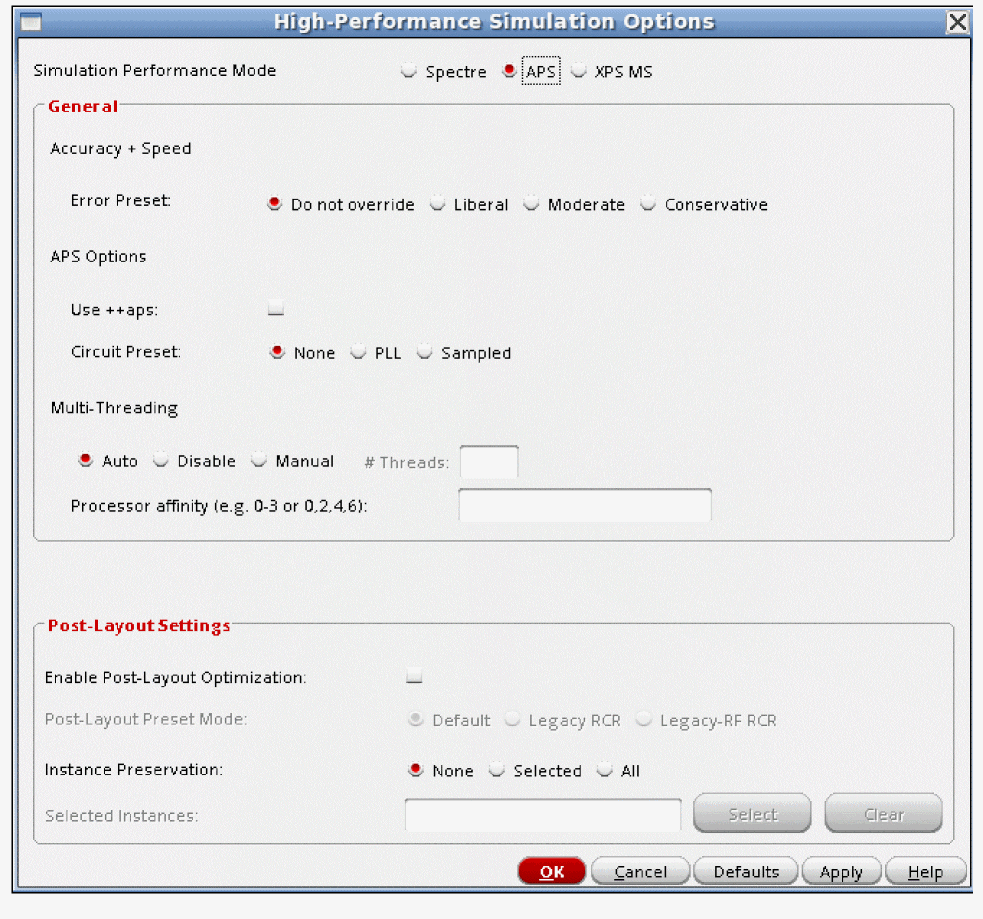
APS makes the CMOS models more efficient and allowing multi-threading for the device current evaluation. This will be relatively more efficient on schematic-level circuits and adds the transient APS algorithms for DC and tstab solutions. It also allows multi-threading for all the matrix operations for Harmonic Balance and shooting and their small-signal analyses.
The processor affinity field should be used when you are running two or more jobs on the same multi-core machine. For example, if you have an 8 core machine and you are running two 4-thread jobs; assigning one job to cores 0 through 3 and the other to 4 though 7 saves time by having the operating system always use the same range of cores. This can save some time since the OS has less work to do. Note that if one of the cores you assign the job to already has a job, the entire simulation will run slowly because that one core will need to run two jobs by sharing time between them. The assumption is that all the threads will run on cores that are fully dedicated to the APS job.
Large vs. Small Signal Analysis
SpectreRF provides a variety of time-varying small signal analysis for both periodic and quasi-periodic circuits. These small-signal analyses accurately model the frequency translation effects of time-varying circuits. Rather than using traditional small-signal analyses for circuits that exhibit no frequency translation, such as amplifiers and filters, you can simulate circuits that translate frequencies using time-varying small-signal analyses.
Circuits designed to translate from one frequency to another include mixers, samplers, frequency multipliers, phase-locked loops and parametric oscillators. Such circuits are commonly found in wireless communication systems.
Other circuits that translate energy between frequencies as a side effect include oscillators, switched-capacitor and switched-current filters, chopper-stabilized and parametric amplifiers, and sample-and-hold circuits. These circuits are found in both analog and RF circuits.
The quasi-periodic small-signal analyses accurately model the small signal characteristics of circuits with a quasi-periodic operating point, such as mixers with multiple LO frequencies or large RF inputs. The periodic small-signal analyses are more useful for circuits with a single input frequency.
Applying a time-varying small-signal analysis is a two-step process.
First, the simulator ignores the small input or noise signals while performing a PSS, QPSS or Hb analysis to compute the steady-state response to the remaining large-signals, such as the LO or the clock. The PSS or QPSS analysis is the full nonlinear solution for the circuit.
For each subsequent small-signal analysis, the simulator uses the nonlinear operating point computed by the PSS, HB, or QPSS analysis to predict the circuit response to a small sinusoid at an arbitrary frequency. You can perform any number of small-signal analyses after calculating the time-varying large-signal operating point.
The input signals for the small-signal analyses must be sufficiently small that the circuit does not respond to them in a significantly nonlinear fashion. You should use input signals that are at least 10 dB smaller than the 1 dB compression point. This restriction does not apply to the signals you apply in the large-signal analysis.
This two-step process is widely applicable because most circuits that translate frequency react in a strongly nonlinear manner to one stimulus, usually either the LO or the clock, while they react in a nearly-linear manner to other stimuli such as the inputs. A mixer is a typical example. Its noise and conversion characteristics improve if it is discontinuously switched between two states by the LO, yet it must respond linearly to the input signal over a wide dynamic range.
To analyze a mixer with a small RF input and a single LO, you should use a PSS large-signal analysis using shooting or hb as the engine followed by one or more of the PAC, Pnoise, PSP or PXF small-signal analyses.
If the mixer has a small RF input and a large blocker as well as the LO, then a QPSS analysis would be the more appropriate large-signal analysis. Follow the QPSS analysis with one or more of the QPAC, QPNoise, QPSP or QPXF small-signal analyses for the RF input. The basic idea is this: If you have signals in your circuit that cause large-signal effects (like a blocker) this signal must be applied in a large-signal analysis like PSS for one input, or QPSS (or HB) for multiple inputs. For signals that are largely linear (like the conversion product of a receive mixer), you can use small-signal analyses which run faster. If the signals are largely sinusoidal, then hb and the small-signal analyses hbac, hbnoise, and hbsp can also be used.
Some circuits, such as frequency dividers, generate subharmonics. PSS can simulate the large-signal behavior of such circuits if you specify the period T to be that of the sub-harmonic. For other circuits, such as delta-sigma modulators, the periodically driven circuits respond chaotically, and you must use transient analysis rather than the PSS or QPSS analyses.
With the time-varying small-signal analyses such as QPAC or PXF, unlike traditional small-signal analyses such as AC or XF, there are many transfer functions between any single input and output due to mixing with harmonics. Usually, however, only one or two harmonics provide useful information. For example, when you analyze the down-conversion mixers found in receivers, you want to know about the transfer function that maps the input signal at the RF to the output signal at the IF, which is usually the LO minus the RF.
Return to top