
shapeRequiredClearance
Requires the existence of another shape on a different layer. The direction of measurement of the other shape must be either vertical or horizontal and must be present for the full parallel run length.
shapeRequiredClearance Quick Reference
Value Types
shapeRequiredClearance constraint has the following value types:
-
RangeArrayValuespecifies that there must be at least one layer2 shape within one of these ranges from layer1. -
RangeArray1DTblValuespecifies the ranges within which at least one layer2 shape must exist for a layer1 shape of a given width.
Parameters
-
oaSpacingDirection(StringAsIntValue, required) specifies the measurement direction in which the distance to the layer2 shape is measured anyDirection 0 Horizontally and vertically (default) horizontalDirection 1 Horizontally only verticalDirection 2 Vertically only -
twoSides(BoolValue, optional) if true, specifies that the layer2 shape is required on both the sides. The default value of this parameter is false. -
widthRangeArray(RangeArrayValue, optional) specifies that the constraint only applies to those shapes on Layer1 whose widths are in this range. -
sideExtension(Value, optional) specifies the extent to which layer1 should be extended orthogonally to measurement direction before measuring its distance from layer2.
Examples
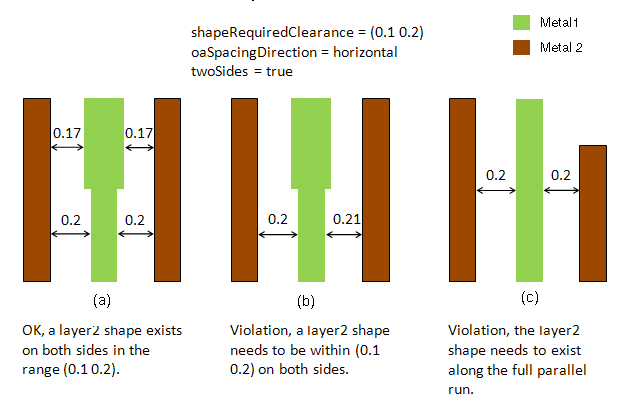
Example 1 — shapeRequiredClearance using twoSides
In this example, the clearance between the shape on Metal1 and the required shape on Metal2 must be greater than 0.1µm and less than 0.2µm under the following conditions:
-
The distance to the
Metal2shape is measured in the horizontal direction. -
A
Metal2shape is required on both sides.
Example 2 — shapeRequiredClearance using sideExtension
In this example, the clearance between the shape on Metal1 and the required shape on Metal2 must be greater than 0.1µm and less than 0.2µm under the following conditions:
-
The distance to the
Metal2shape is measured in the horizontal direction. -
The
Metal1is extended orthogonally by 0.05 in the vertical direction before measuring its distance fromMetal2.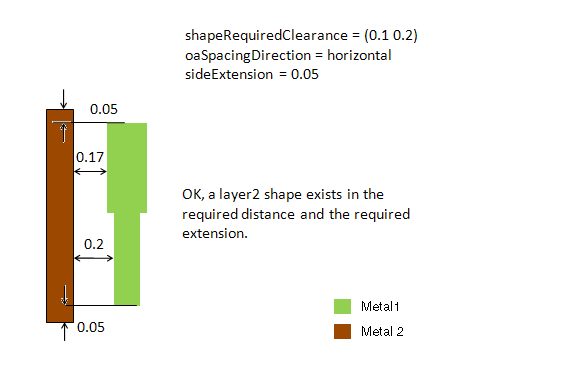
Related Topics
Return to top