
Your license file determines your license configuration. When your company ordered your Cadence products, your company specified
- A license-server configuration
- Single License Server
- Multiple, Independent License Servers
- Fault-Tolerant License Servers (UNIX only)
- The identification numbers (host IDs) of the computer systems designated to be the Cadence license servers
You must use the computer systems specified as the license servers.
- Possibly, the host name of the license server
Your license file includes this information as well as the licenses for the Cadence products ordered for your site. You can determine your type of licensing configuration by looking at the number of SERVER lines in your license file.
|
Number of SERVER Lines |
License-Server Configuration |
|
One |
Single license server or standalone workstation |
|
Three (UNIX only) |
Fault-tolerant license server |
|
Neither one nor three |
Invalid license file |
Your license agreement with Cadence usually prohibits using a floating license outside of a one-mile (1.6 km) radius. To use your license on a Wide Area Network or outside the one-mile radius, contact your Cadence account representative.
Single License Server
With a single license server, one license server manages all Cadence licenses. A benefit of this setup is its ease of maintenance. Cadence recommends this setup if there are few users.
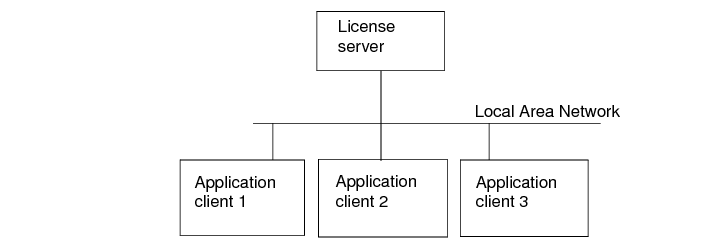
Note: You would configure a standalone workstation as a single license server.
Multiple, Independent License Servers
With multiple, independent license servers, several license servers distribute Cadence licenses. The benefit of using this configuration is that other license servers can automatically serve users if the server in operation goes down. A multiple, independent license-server configuration looks similar to this one.
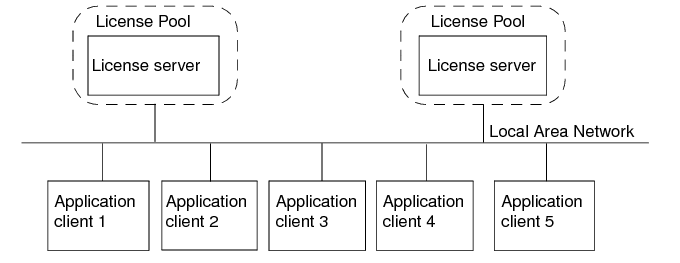
Each license server uses its own license file and distributes licenses independently. For example, if your network includes two license servers, one license server could distribute copies of the Allegro™ product while the other distributes copies of the Analog Workbench™ and Verilog-XL™ products.
You can set up multiple, independent license servers if you receive several license files, one for each license server. A single workstation can only act as a license server for one Cadence license file at a time.
Fault-Tolerant License Servers
With fault-tolerant (redundant-server) licensing, three license servers act as one "logical" license server--they manage a group of licenses that all application clients share. The one primary (master) and two secondary (standby or slave) license servers always know who is using what features. Two license servers must be up and running to serve licenses.
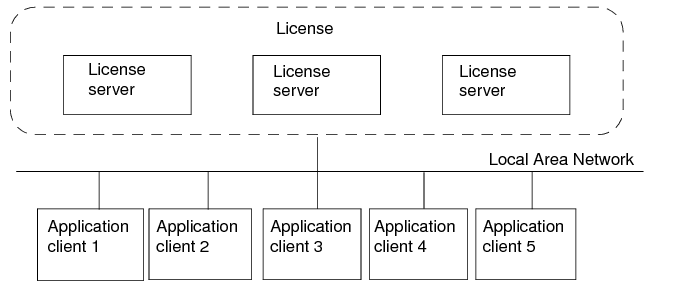
This redundancy provides fault-tolerant licensing by allowing continued access to licenses, even when one license server becomes unavailable (through a crash or an intentional shut down). If the master license server crashes, one of the remaining two license servers becomes the master. Each license server must have its own copy of the Cadence licensing software and license file. Users can still work if one of the license servers goes down, as long as two of the three servers maintain contact with each other.
Fault-tolerant licensing depends on a reliable network. A reliable, dedicated license server, possibly with restricted user access, can be a viable substitute for fault-tolerant license servers.
You cannot have fault-tolerant licensing with only one license server.
You can set up fault-tolerant licensing if
- You ordered the Cadence licenses for fault-tolerant licensing
- The license file lists three license servers (the license file has three SERVER lines--one entry for each license server)
- The license servers are on the same local area network so that they can communicate reliably with each other
- The three license servers are on the same hardware platform, run the same version of the UNIX operating system, and use the same version of Cadence licensing software
- Each license server has the same license files