
proute_core_ring
proute_core_ring
-layers {s_layerName s_layerName …}
-nets {s_netName…}
{-net_width f_userunit | -layer_width {f_width …}}
[ -contour [ true | false ] [ -min_jog f_userunit ] ]
[ -core_clearance f_userunit
 | -pad_clearance f_userunit
 | -in_area_clearance f_userunit
   {-routing_area {f_xlo f_ylo f_xhi f_yhi}
   | -routing_area {f_x1 f_y1 f_x2 f_y2 f_x3 f_y3 f_x4 f_y4
                  f_x5 f_y5 f_x6 f_y6 …}
   | -use_border_blockage}
 | -out_area_clearance f_userunit
   {-routing_area {f_xlo f_ylo f_xhi f_yhi}
   | -routing_area {f_x1 f_y1 f_x2 f_y2 f_x3 f_y3 f_x4 f_y4
                  f_x5 f_y5 f_x6 f_y6 …}} ]
[ -depopulate {[L] [B] [R] [T] [H] [V]} ]
[ -ignore_obstacles [ true | false ] | -ignore_purposes {s_purposeName…} ]
[ -lattice [ true | false ] ]
[ -net_clearance f_userunit ]
[ -power_only [ true | false ] ]
[ -silent [ true | false ] ]
[ -undoable [ true | false ] ]
Description
Adds rings around the core of a design that has pads, around the entire design without pads, inside the design bounds, or inside or outside of a given region.
The ring location is dependent on the optional setting of one of the following ring location reference arguments:
-
-core_clearance -
-pad_clearance -
-in_area_clearancewith-routing_areaor -use_border_blockage -
-out_area_clearancewith-routing_area
If none of these arguments is given and peripheral pads exist, then the rings are centered in the area between the core and the pads. If peripheral pads do not exist, rings are placed starting from the minimum clearance outward from the design bounds.
The core bounds is the rectilinear outline of the outermost prBoundaries of all non-pad, non-standard cell instances, and, if rows are defined, the bounds of all rows, or, if no rows are defined, the prBoundaries of all standard cells.
The design bounds is the prBoundary of the top-level design (occurrence). If no prBoundary is defined, then the design bounds is the bounding box of the design.
Arguments
Examples
No Ring Location Reference Arguments Given
If the design has peripheral pads, the core rings are centered in the area between the pads and the core of the design. If the design has no pads, the core rings surround the entire design starting from minClearance, outward from the design boundary.
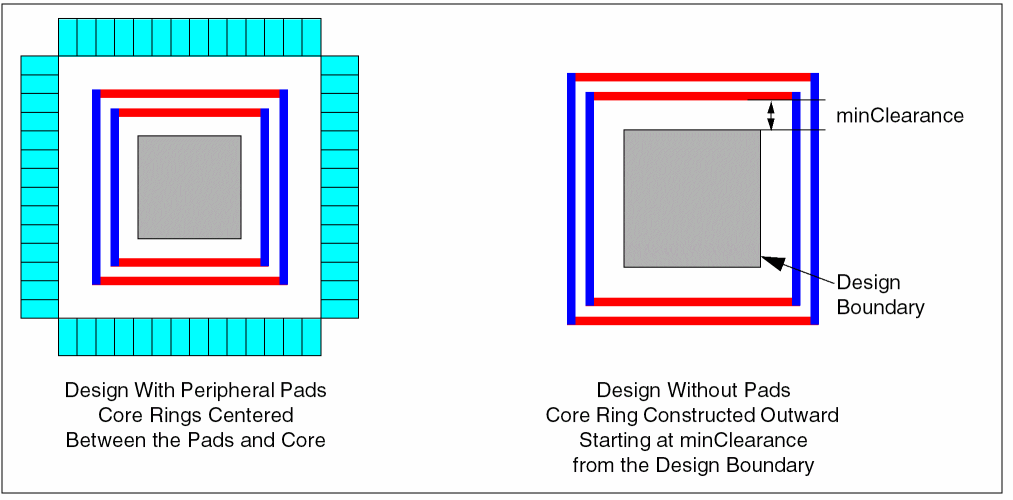
The following example adds core rings for VDD and VSS on adjacent layers, met2 and met3. If pads are present, the core rings are centered between the pads and the core. If pads do not exist, the core rings are constructed starting from minClearance outward from the design boundary.
proute_core_ring -layers {met2 met3} -net_width 8 -net_clearance 2 -nets {VDD VSS}
With -core_clearance
If the design has peripheral pads, the core rings are created outward starting at core_clearance from the core boundary or, if peripheral pads do not exist, the core rings are created outward starting at core_clearance from the design bounds.
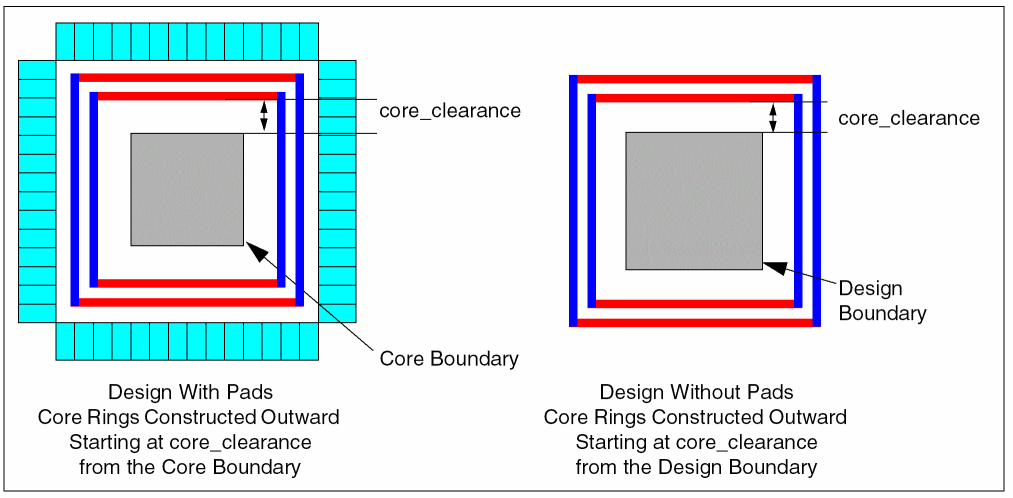
The following example adds core rings for VDD and VSS on adjacent layers, met2 and met3. If pads are present, the core rings are constructed outward starting at core_clearance from the core boundary. If pads do not exist, the core rings are constructed outward starting at core_clearance from the design boundary.
proute_core_ring -layers {met2 met3} -net_width 8 -net_clearance 2 -nets {VDD VSS} -core_clearance 0.6
With -pad_clearance
If the design has peripheral pads, the core rings are created inward starting at pad_clearance from the pads or, if peripheral pads do not exist, the core rings are created inward starting at pad_clearance from the design bounds.
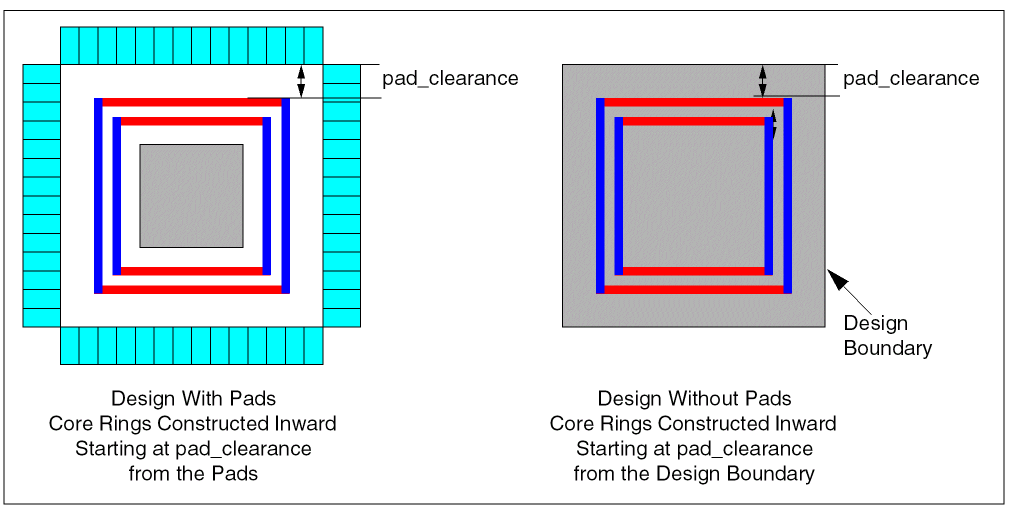
The following example adds core rings for VDD and VSS on adjacent layers, met2 and met3. If pads are present, the core rings are constructed inward starting at pad_clearance from the pads. If pads do not exist, the core rings are constructed inward starting at pad_clearance from the design boundary.
proute_core_ring -layers {met2 met3} -net_width 8 -net_clearance 2 -nets {VDD VSS} -pad_clearance 0.6
With -in_area_clearance
When -in_area_clearance is given, the core rings are created inward starting at in_area_clearance from the routing_area.
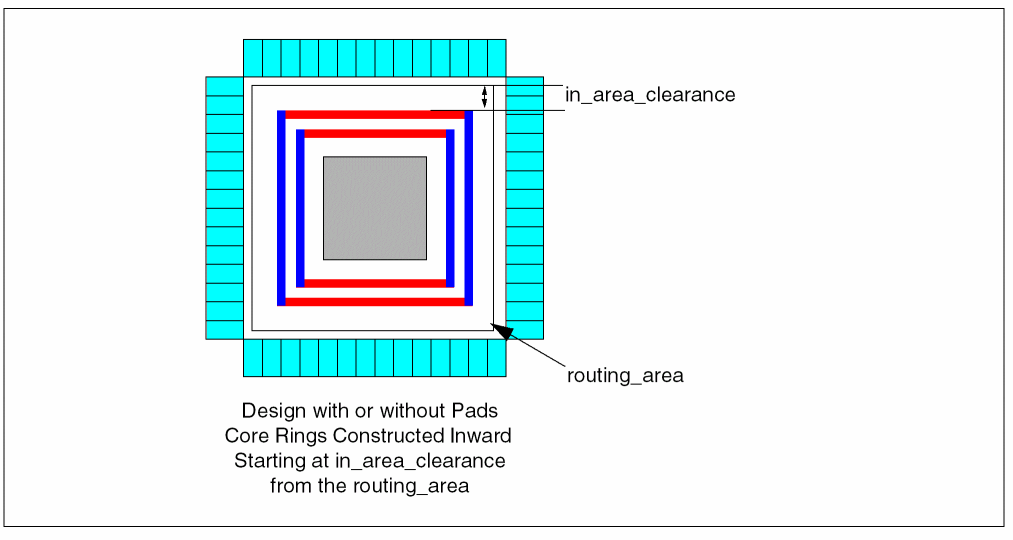
The following example adds core rings for VDD and VSS on adjacent layers, met2 and met3. The core rings are constructed inward starting at in_area_clearance from the routing_area.
proute_core_ring -layers {met2 met3} -net_width 8 -net_clearance 2 -nets {VDD VSS} -in_area_clearance 0.6 -routing_area [get_window_area]
With -out_area_clearance
When -out_area_clearance is given, the core rings are created outward starting at out_area_clearance from the routing_area.
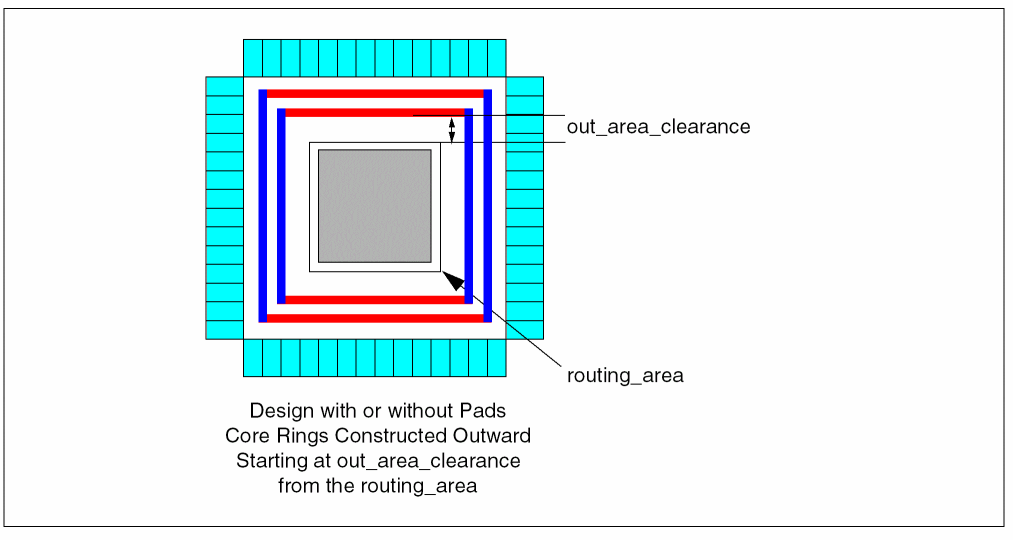
The following example adds core rings for VDD and VSS on adjacent layers, met2 and met3. The core rings are constructed outward starting at out_area_clearance from the routing_area.
proute_core_ring -layers {met2 met3} -net_width 8 -net_clearance 2 -nets {VDD VSS} -out_area_clearance 0.6 -routing_area { 100 100 550 600 }
Related Topics
Return to top