
Pseudoparallel Connections
A pseudoparallel connection is defined as a group of instance terminals on a net that are at the same voltage, due to which they do not need a physical connection.
It is similar to a must-connect; the only difference being that it is implemented not using pins but using instance terminals that belong to a specified net. The main advantage of recognizing that a net can be made pseudoparallel is that it saves space because less routing is required to connect it.
What is a Pseudoparallel Connection
Consider a simple inverter comprising an NMOS and PMOS pair. If you set an mfactor of 2 on the inverter, when it is flattened in the layout, the connectivity is as represented below.

The broken line represents an internal net connecting the source and drain of each PMOS and NMOS. This net has four instance terminals; however, the router does not need to make a physical connection from the P.1/ N.1 pair to the P.2/N.2 pair in order for the circuit to function correctly. Because it is mfactored, the nets connecting to all the other terminals of P.1 and P.2 are exactly the same, as are the nets connecting to all the other terminals of N.1 and N.2. Therefore, the voltage on the node between P.1 and N.1 is the same as that on the node between P.2 and N.2, removing the need to connect them up with a wire.
To represent this situation in the database, the instance terminals are partitioned into subnets. Each subnet on a pseudoparallel net contains two instance terminals which must be connected together, but no connection is necessary between the instance terminals on different subnets.
In the example above, there would be two subnets. The instance terminals from P.1/N.1 would be contained in one of them, representing the fact that they must be connected in order for the circuit to work. The instance terminals from P.2/N.2 would be in the other, again representing the fact that they must be connected in order for the circuit to work. But no connection is required between the two. The circuit would work equally well without the connecting wire, as shown below.

The model extends depending on the mfactor employed. In the example above, if the mfactor is x, then for the “internal” net connecting all the sources and drains together there are a total of x subnets each containing two instance terminals.
Layout XL does not consider the mfactor in the source when determining whether a net is pseudoparallel or not. Instead it considers the net, the instances attached to it, and all the other connections to those instances. In general, any time there is a pair of devices in series in the schematic, each with the same mfactor value, then the net implementing the series connection can be made pseudoparallel in the layout.
Examples of Pseudoparallel Connections
Pseudoparallel connections are useful in situations like the one shown below.
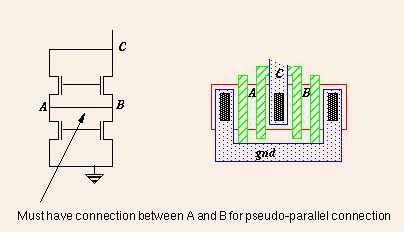
In this example, nodes A and B can be considered equipotential, i.e., there is no current flowing through them. You can save area in your design if this connection is skipped, even though the connectivity reference requires all instance terminals on the same net to be physically connected. With pseudoparallel connections on A and B, no physical connection is required between the two instance terminals even though they are on the same net.
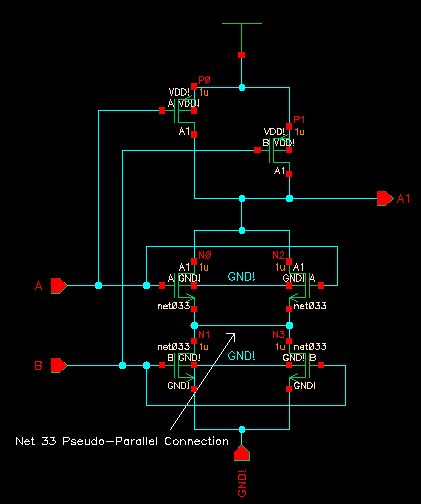
The picture below shows an explicit pseudoparallel connection of two or more groups of parallel devices in series.
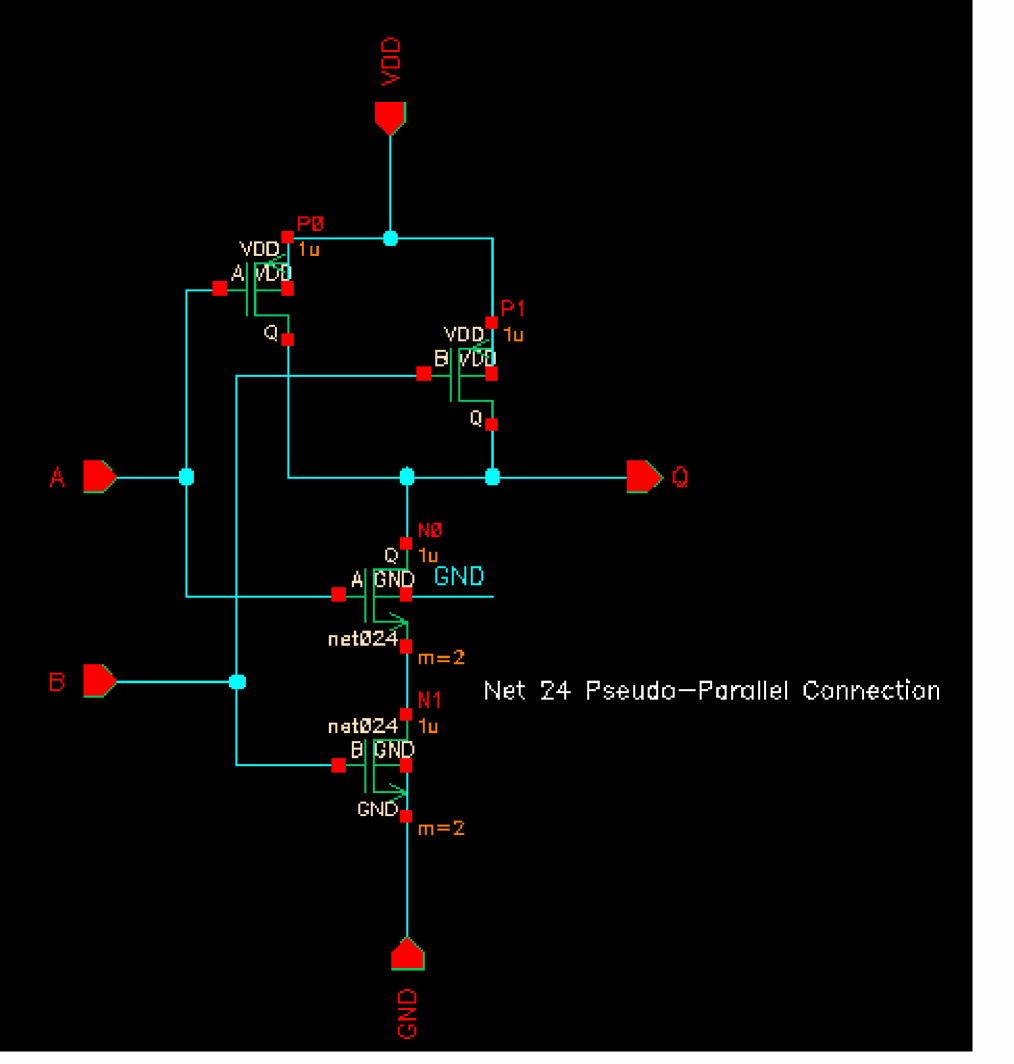
The picture below shows an implicit pseudoparallel connection of two or more groups of mfactored devices in series.
Layout XL automatically finds possible pseudoparallel connections and treats them so when you generate the layout using the Generate All From Source command.
If the layout exists already, you can create pseudoparallel connections automatically by running the Update Components And Nets command.
Related Topics
Defining a Pseudoparallel Connection.
Return to top