
Dynamic Floating Gate Induced Leakage Check (dyn_floatdcpath)
Spectre Syntax
title dyn_floatdcpath net=[n1 n2 ...] <leaki_times=[t1 t2 …]> ith=<value> error_limit=<value> <save=no|violation> <spice=no|yes> <detailed_path=[yes|per_fm|per_fn]> <sort=[no|current]> res_th_va=<value> res_th=<value> isource_ith=<value> bjt_vbe=<value> bjt_ith=<value> diode_vth=<value> <floatgate=[yes|no|gate_has_driver_no_cap]> node=[n1 n2...] xnode=[n1 n2...] <inst=[inst1 inst2...]> <xinst=[xinst1 xinst2...]> <subckt=[subckt1 subckt2....]> <xsubckt=[xsubckt1 xsubckt2....]>
SPICE Syntax
.cck title dyn_floatdcpath net=[n1 n2 ...] <leaki_times=[t1 t2 …]> ith=<value> error_limit=<value> <save=no|violation> <spice=no|yes> <detailed_path=[yes|per_fm|per_fn]> <sort=[no|current]> res_th_va=<value> res_th=<value> isource_ith=<value> bjt_vbe=<value> bjt_ith=<value> diode_vth=<value> <floatgate=[yes|no|gate_has_driver_no_cap]> node=[n1 n2...] xnode=[n1 n2...] <inst=[inst1 inst2...]> <xinst=[xinst1 xinst2...]> <subckt=[subckt1 subckt2....]> <xsubckt=[xsubckt1 xsubckt2....]>
Description
Reports the DC leakage paths that are caused by floating gate. The check based on leakage analysis is evoked when parameter leaki_times is specified. leaki_times should be carefully selected in standby or power-down mode. The check is performed for a transient simulation at the time points specified by leaki_times.
Worst leakage paths caused by floating gate MOSFET devices are estimated and reported. The leakage paths are checked between the specified power supply nodes (net).
The floating node detection and path detection in the leakage analysis-based method comprises of two steps.
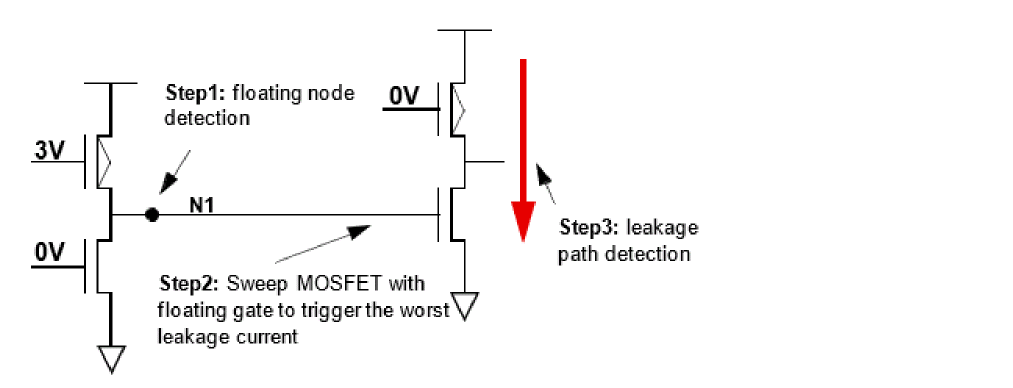
Step 1: Floating node detection
This stage is like dyn_higz check. A node is considered floating (or in high impedance state) if it has no conducting path to a power supply or ground. A report of all MOSFETs with floating gates can be printed by using the parameter floatgate. The following device conducting rules are used for floating node detection:
-
A MOSFET is considered to be conducting if
regionis eithertriodeorsaturation. -
Resistors, controlled resistors, phy_res, relay, and inductors are considered to be conducting if
R<= res_th. -
A BJT is considered to be conducting if
vbe>bjt_vbeoric>bjt_ith. -
A diode is considered to be conducting if
v>diode_vth. - Vsource, and iprobes are considered to be conducting.
-
Isources, VCCS, and CCCS are considered to be conducting if
i>isource_ith. - A JFET is considered to be conducting.
- Mutual inductors and controlled capacitors are considered to be non-conducting.
- In Verilog-A, conducting path depends on module details
Step 2: Current path detection
In the violation report of dyn_floatdcpath, the current is not from a transient simulation, but from the estimation of a worst scenario and the purpose is to trigger the violations.
The current path detection is like dyn_dcpath. If more than two nets are specified, Spectre checks the leakage path between each pair of nets. For example, if net=[vdc1 vdc2 0], the conducting path between vdc1 and vdc2, vdc1 and 0, and vdc2 and 0 is checked.
Arguments
Example
dyn1 dyn_floatdcpath net=[vdd1 0] leaki_times=[7.5n]
This example reports the high impedance node induced DC leakage paths between the nets vdd1 and 0 at the specified leaki times based on leakage analysis. This examples displays the following report in the Web browser.
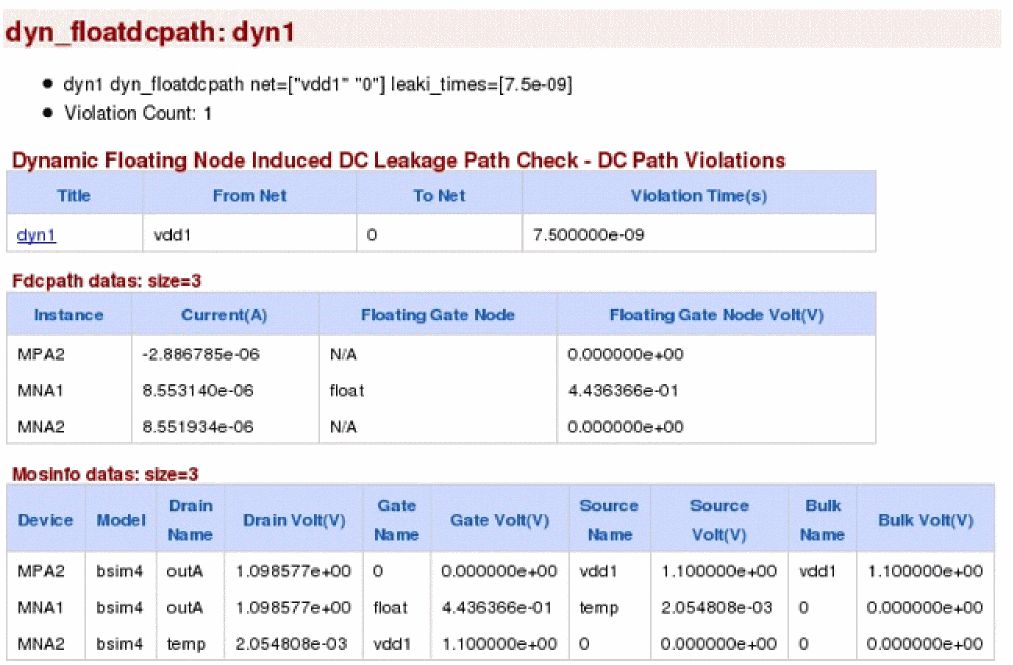
The report contains the following three sections:
-
The first section shows the From Net
vddTo Net0between which the path is found. -
The second section shows the actual instances in the path. The first column
Instanceshows instances in the path. The second columnCurrent (A)shows the current through the instances. The third columnFloating Gate Nodeestablishes the link between the floating gate node and MOSFET. The third column may contain either a node name or N/A. If it contains a node name, it means that the corresponding element is a MOSFET whose gate is floating. The fourth column shows the voltage of the floating gate. -
The third section shows the state of MOSFETs in the path. It does not report anything other than MOSFET. The first column
Deviceis the MOSFET name. The second columnModelshows the model name. The remaining columns show the terminal names and voltages.
Related Topics
Return to top