
Setting Properties on an Instance
Instance properties apply to only one instantiation of a cell (unlike cell properties that apply to all the instantiations of a cell). However, that instance properties can apply to multiple objects—if the cell that contains the instance is used in multiple places in the design, the property applies to the instance in all those locations.
Instance properties are also inherited by all objects in the hierarchy below the instance, unless a property’s definition specifies that it cannot be inherited.
Instance-level properties override properties set at the global or cell level and can be overriden at the occurrence level.
Setting Instance Properties from the Tree View
To set a property on an instance from the tree view of the Hierarchy Editor,
- Choose View – Tree to display the tree view of the configuration, if it is not already displayed.
-
If the Occurrence Mode button on the toolbar is selected, deselect it.
The tree view now displays Target: Instance.
If an instance has already been identified as an occurrence, the tree view displays Target: Occurrence when it is selected, and any property you set on it gets added to the occurrence, not the instance. -
Choose View – Properties.
Property columns are displayed for all the properties that are defined in the property dictionary or in theprop.cfgfile. -
In the Tree View section, click the property column of the instance on which you want to set the property and either type in the value or select it from the drop-down list.
Properties of typeenumhave a drop-down list of values from which you select a value. Properties of other types, such as integer or string, have an editable field. For example: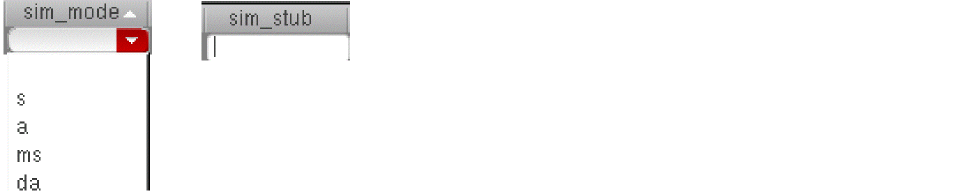
Setting Instance Properties from the Table View
To set a property on an instance from the table view,
- Choose View – Parts Table and View – Instance Table to display the table view of the Hierarchy Editor, if it is not already displayed.
-
Choose View – Properties.
Property columns are displayed for all the properties that are defined in the property dictionary or in theprop.cfgfile. -
In the Cell Bindings section, select the cell that contains the instance on which you want to set the property.
The Instance Bindings section displays all the instances the cell contains. -
In the Instance Bindings section, click in the property column of the instance on which you want to set the property and either type in the value or select it from the drop-down list.
Properties of typeenumhave a drop-down list of values from which you select a value. Properties of other types, such as integer or string, have an editable field.
You cannot add an instance property to an object that has already been defined as an occurrence (identified by a icon). To do so, you must remove the occurrence binding first.
To see which objects the property applies to,
- In the Cell Bindings section in the table view, right-click the cell that contains the instance on which you set the property.
-
From the pop-up menu, select Explain.
The Explain dialog box appears. The Instantiations section lists the instantiations of the cell. The property gets applied to the instance in all these instantiations of its parent cell.
To see the hierarchy below the instance to which the property also applies,
- Choose View – Tree to display the tree view of the configuration.
- Double-click the instance or click its expansion icon.
Related Topics
Properties Setting on the Design
Setting Properties on a Global Basis
Setting Properties on an Occurrence
Return to top