
Model Concepts
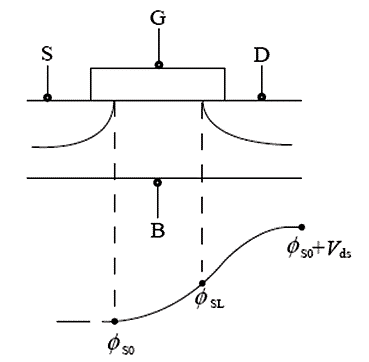
HiSIM (Hiroshima-university STARC IGFET Model) is the first complete surface-potential-based MOSFET model for circuit simulation based on the drift-diffusion theory, which was originally developed by Pao and Sah. The most important advantage of the surface-potential-based modeling is the unified description of device characteristics for all bias conditions. The physical reliability of the drift-diffusion theory has been proved by 2D device simulations with channel lengths even down to below 0.1um.
Figure -1 Schematic of the surface potential distribution in the channel
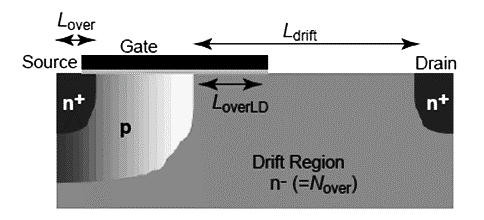
The most important feature of LDMOS/HVMOS devices, different from the conventional MOSFET, is that the drift region is introduced to achieve the sustainable high voltages. By varying the length as well as the dopant concentration of the drift region, various devices with various operating bias conditions are realized as shown in Fig. 31-2 or the LDMOS structure. In any cases, the drift region affects as the resistance for the current flow and also induces additional charge, which causes the especially unique features of the LDMOS capacitances. Thus accurate modeling of the drift region is the main task of HiSIM_HV.
Figure -2 Schematic of the typical LDMOS structure and device parameters
For the LDMOS/HVMOS device the iterative solution is only one possible solution to model the specific features of this device accurately, because the resistance effect in the drift region is dependent on the bias condition as well as the geometrical structure. The basic modeling method is taken over from the HiSIM2 model, and additional equations for capturing the drift-region effects are included. Since the overlap length is relatively long for LDMOS/HVMOS, accurate surface potential calculation for the overlap region is also necessary for accurate prediction of the high-voltage MOS capacitances.
For the LDMOS/HVMOS device the iterative solution is only one possible solution to model the specific features of this device accurately, because the resistance effect in the drift region is dependent on the bias condition as well as the geometrical structure. The basic modeling method is taken over from the HiSIM2 model, and additional equations for capturing the drift-region effects are included. Since the overlap length is relatively long for LDMOS/HVMOS, accurate surface potential calculation for the overlap region is also necessary for accurate prediction of the high-voltage MOS capacitances.
Three types of devices structure can be modeled since HiSIM_HV version 1.2.0 and 1.1.1: Asymmetrical LDMOS, Symmetrical HV-MOS and Asymmetrical HV-MOS. Model parameter COSYM determines the devices symmetry and Ldrift, the overlap length Lover, as well as the impurity concentration of the drift region Nover determine the characteristics of respectively side. In the LDMOS case independent structures at the source side and the drain side are distinguished, and the Ldrift region is not introduced at the source side. In the HVMOS case, the parameter values for the drain side have to be determined, and are copied to the source side automatically. If parameters for the source side are determined explicitly, these values are taken. If parameters are not determined, values at the drain side are taken. If the parameter values are not determined, default values are taken. This is valid for any structural cases. Fig. 31-3 shows three different devices structures and table 31-1 shows the model parameters used by different structures.
Figure -3 Three different devices structure and related model parameters
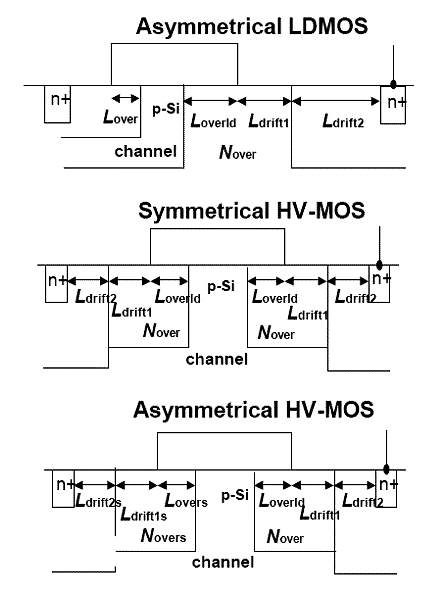
Table -1 The different model parameters used by different structures
Return to top