
Noise
The noise model comprises two body components, a thermal (white) noise component and a flicker (1/f ) noise component, thermal noise components for each contact resistance, and short noise components for each parasitic diode. These components are noise current spectral density (in A2/Hz ) that are implemented as a noise current sources in parallel with the associated element.
The thermal noise component of the resistor body is based on its DC conductance,
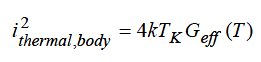
where k is Boltzmann’s constant, TK is the device temperature (in Kelvin, including the effect of self-heating), and Geff is the effective conductance of the resistor (at the temperature T ). Similarly the thermal noise of each end resistances is
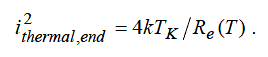
The flicker noise component is DC current dependent and scales with geometry per the physical restrictions mentioned earlier.
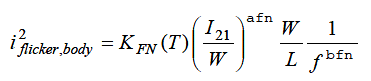
where f is frequency (in Hz ), afn and bfn are model parameters, KFN(T ) is the temperature dependent flicker noise coefficient, I21 is the DC current in the resistor body, and W and L are the resistor width and length respectively, in units micron (µm). If the switch parameter for flicker noise geometry calculation sw_fngeo is 0 (false) then W and L are design geometries, w_um and l_um respectively, else if it is 1 (true) then W and L are effective geometries, weff_um and leff_um respectively.
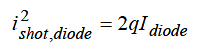
for each parasitic diode, where Idiode is the current in the diode.
Return to top