
Temperature Dependence
The zero-bias resistance R0 varies with temperature as

where R0 is the nominal value of the zero-bias resistance at the nominal temperature tnom and tfac is the resister temperature factor, given by

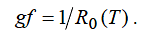
where dT is the temperature difference (including self-heating) with respect to tnom, and TeffC1 and TeffC2 are first (linear) and second (quadratic) order effective temperature coefficients. Smooth limiting of the resistance temperature factor tfac is implemented to a minimum value of 0.01. The conductance factor is then
The depletion potential has a temperature dependence in version 1.1.0, given by

The velocity saturation temperature dependence in version 1.1.0 is activated by the parameter sw_vsatt. If sw_vsatt = 0, then there is no temperature dependence; this is the default for compatibility reasons. If sw_vsatt = 1, then the corner and critical fields for velocity saturation are adjusted according to

where rT is the ratio of device to nominal temperature (in Kelvin), xvsat is a model parameter, and tfac is the same temperature factor as the resistor body.
The end resistances vary with temperature as

and again the temperature coefficient in (30) is limited to a lower value of 0.01. The anomalous increase in conductance with Vds for some p-body resistors is due to contact resistance self-heating and negative temperature coefficients; this was pointed out in [3].
The parasitic diode saturation currents vary with temperature as
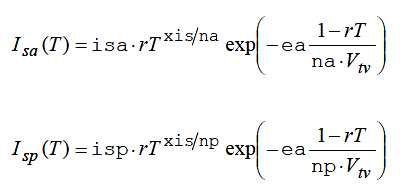
where rT is the ratio of device to nominal temperature (in Kelvin), and Vtv = kT/q is the thermal voltage. The temperature dependence of the junction built-in potentials is
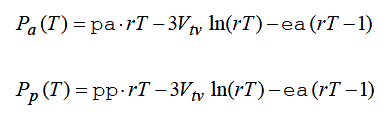
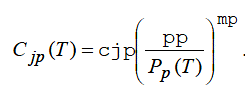
with a physically based modification to smoothly limit the potential to zero for high temperatures, and not allow it to become negative. The area and perimeter junction zero-bias capacitance temperature variations are
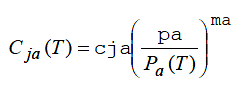
The flicker noise coefficient varies with temperature as

where kfn and tc1kfn are model parameters (and the resulting KFN is clipped to zero as a lower limit).
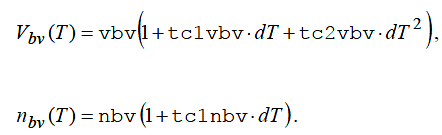
The breakdown voltage and ideality factor vary with temperature as
Return to top