
minQuadrupleExtension
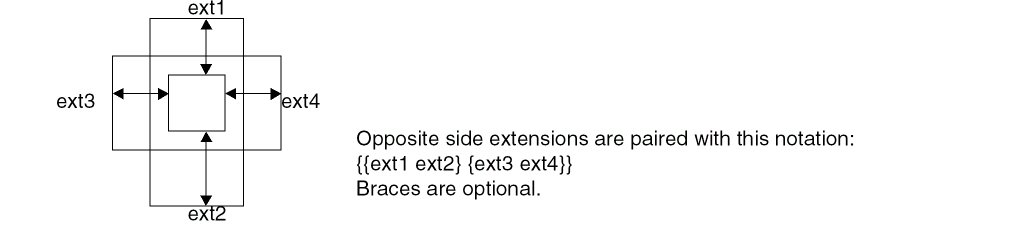
Specifies the minimum extension of a shape on layer1 with a given minimum width past a shape on layer2. The extension of a shape on layer1 can have up to four different values specified to apply to the four sides of the layer2 shape, which is typically a square or rectangle. The first two extensions apply to one pair of opposite edges (for example, top and bottom, or left and right), and the other two extensions apply to the remaining pair of opposite edges.
Usually, an OR constraint group should contain only settings of the same constraint with different parameters. If any of the settings is satisfied, the constraint requirement is met. The exception is that minQuadrupleExtension, minDualExtension, and minWireExtension can be bound together in an OR group and if any of the constraints is satisfied, the extension requirement is met.
minQuadrupleExtension Quick Reference
Value Types
minQuadrupleExtension constraints have a OneDDualArrayTblValue which is indexed by wire width, in user units. Each row contains a minimum width, the number of extension pairs associated with the width, and the extension DualValue pairs. Each DualValue pair specifies an extension quadruple. The first DualValue specifies the first two extension values on opposite sides, and the next DualValue specifies the remaining two extension values for the other two opposite sides.
#                     width #pairs 1st pair     2nd ext pair
-OneDDualArrayTblValue {0.3 2      {0.05 0.05}  {0.08 0.1}}
For a wire greater than or equal to 0.3 user units in width, a via touching or overlapping the wire must have minimum extensions of {0.05 0.05} on opposite sides, and {0.08 0.1} on the other two opposite sides.
Parameters
-
cutClass(DualValue, optional) specifies that the constraint only applies to cut shapes of the specified cut class. -
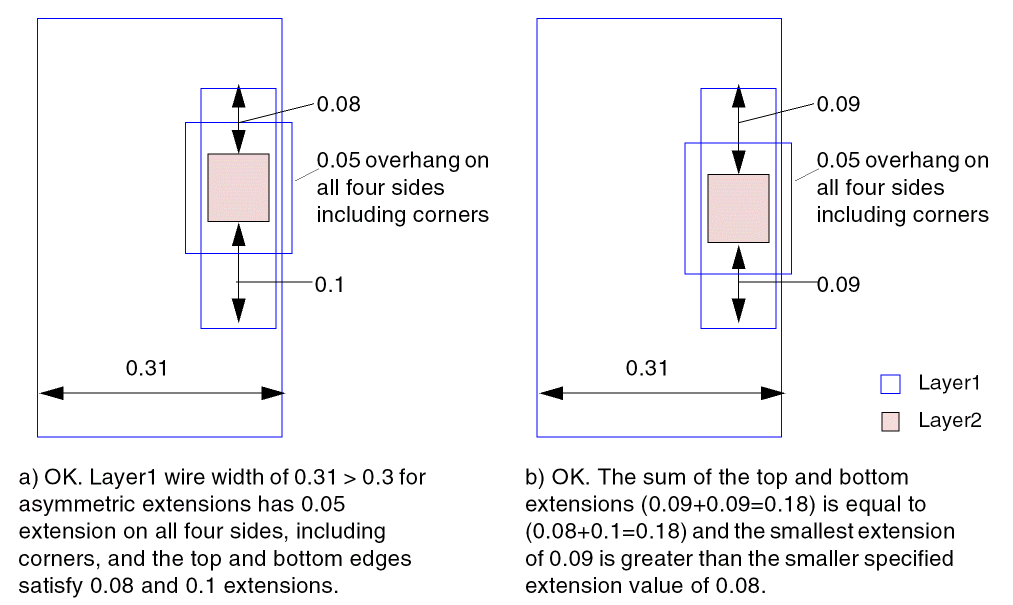
allSides(BoolValue, optional) If true and if any of the extension sets are asymmetric (extension1 is not equal to extension2, or extension3 is not equal to extension4), then the minimum extension on all four sides of thelayer2shape must be greater than or equal to the smallest of the four specified extensions, including the corners. In this case, the extensions for the minimum widthlayer1wire shape, which touches or overlaps thelayer2cut shape are used.
If the parameter is false, then the extensions apply to the maximum widthlayer1wire shape that thelayer2cut shape overlaps or touches. -
extensionType(OneDDualArrayTblValue, optional) specifies special attributes for each set of four extension values in the same table format as the constraint value. All fourextensionTypeinteger values for an extension set should be the same. Valid values are given in the following table.
Examples
- Extension pairs for layer1 wires with minimum width of 0.3 past layer2 cut shapes are {0.05 0.05} and {0.08 0.1}.
-
If any of the extension sets are asymmetric (extension1 is not equal to extension2, or extension3 is not equal to extension4), then the minimum extension on all four sides of the
layer2shape must be greater than or equal 0.05. -
Allows two opposite sides to have any extension, as long as the sum of the two extensions is greater than or equal to the sum of the specified extensions and the smaller extension is greater than or equal to the smaller one of the specified extensions.
Related Topics
Return to top