





|
|
|||||||||
|
|
|
|
|
|
|
|
|
|
|
This chapter introduces the Verilog® value change dump (VCD) and extended VCD (EVCD) file formats, as used in the Virtuoso® UltraSim™simulator, and provides illustrations to explain the signal information file.

|
Four-state - represents variable changes in 0, 1, x (unknown or "not needed") and z (tri-state) without providing strength information and port direction |
|
|
Extended - represents variable changes in all states and provides strength information and port direction |
For more information about EVCD file format, refer to "Enhanced VCD Commands".
Note: A period (.) is required when using SPICE language syntax (for example, .vcd or .evcd).
The Virtuoso UltraSim simulator replaces the end time in the .tran or tran statement with the time specified in the .vcd/.evcd file when autostop=true (default is false). If false is selected, the simulation time specified in the .tran or tran statement remains unchanged. For more information on autostop, refer to Chapter 11, "Digital Vector File Format".
Each vcd or evcd card can only specify one VCD or EVCD file. If a netlist file needs to include multiple VCD or EVCD files, multiple vcd or evcd cards must be used. For example, if a netlist file contains three VCD files, it needs three vcd cards (use the same netlist file format for EVCD files).
Card 1: vcd_include "file1.vcd" "file1.signal"
Card 2: vcd_include "file2.vcd" "file2.signal"
Card 3: vcd_include "file3.vcd" "file3.signal"
Card 1: .vcd "file1.vcd" "file1.signal"
Card 2: .vcd "file2.vcd" "file2.signal"
Card 3: .vcd "file3.vcd" "file3.signal"
Note: A netlist file can include multiple VEC, VCD, and ECVD files.
The Virtuoso UltraSim simulator handles the VCD and EVCD file content as case insensitive, except when called in Spectre® mode. For Spectre mode, use the -spectre option or input file name extension *.scs. Additional case sensitivity can be set using the insensitive option.
The continuous line symbol is the forward slash (\) sign and is rarely used in the VCD file. The beginning of a card is indicated by the $command keyword (for example, .$var), and ends with the $end keyword. If an identifier is longer than 1024 characters, and does not fit into a single line, the \ sign must be used to continue the line.
Comments need to be enclosed within the $comment and $end commands.
In the definition section, the VCD command keywords used to indicate the start of a card begin with a dollar ($) sign. VCD definition commands include: $comment, $date, $enddefinitions, $scope, $timescale, $upscope, $var, and $version. The end of a card is marked with an $end keyword. Multiple lines can be placed between the $command and $end commands.
The Virtuoso UltraSim simulator supports the following VCD definition section commands:
The $date command is used to specify the date of the VCD file created. The Virtuoso UltraSim simulator accepts this command card, but does not process it.
$date May 7, 2001 $end
The $enddefinitions command indicates where the definition section of the VCD file ends. This command card tells the Virtuoso UltraSim simulator to treat the rest of the VCD file as the data section. If this command card is missing, the Virtuoso UltraSim simulator parses the data section incorrectly and issues an error message.
$enddefinitions $end
The $scope command card switches from the current circuit level to a lower circuit level in the design hierarchy.
|
|
The Virtuoso UltraSim simulator ignores scope_type, but the command must still be specified to maintain consistency with standard VCD format. |
|
|
A matching $upscope card must be specified in the VCD file definition section to switch the scope back to the current scope. |
The $timescale command is used to specify the time scale. This time scale applies to all time values in the VCD file, and to its signal information file. The default time is 1 ns.
produces the same result, telling the Virtuoso UltraSim simulator to set the time scale to 1 ns.
The $upscope command card switches from the current circuit level to an upper circuit level in the design hierarchy.
Note: This card must be used after the $scope card to switch the scope back to the top scope.
The $var command defines the bus to be dumped into the data section.
|
The bus type (the Virtuoso UltraSim simulator ignores this information) |
|
|
The identifier used in the data section; it can be a or a combination of printable ASCII characters |
|
Note: If the size is larger than 1, and the index_range is not specified, the Virtuoso UltraSim simulator assigns an index_range of [size-1:0].
The name of the bit is a combination of the reference and the index.
the names of the four bits in bus regA are regA[0], regA[1], regA[2], and regA[3]. The netlist file referencing these VCD sources must match these names.
the name of the bit is b[0]. The card defined a bit, not a bus, as a size of 1.
the names of the four bits in bus regA are regA[3], regA[2], regA[1], and regA[0]. The netlist file referencing these VCD sources must match the names.
The $version command is used to specify the version of the VCD file created. The Virtuoso UltraSim simulator accepts this command card, but does not process it.
$version UltraSim B2001.2.10 $end
In the VCD data section, a time point that starts with a number (#) sign (for example, #100) indicates the beginning of a new card. This card continues until it reads the line before the next card (cards can have multiple lines). It can also contain data values and a command block. A command block begins with one of the following command keywords, $comment or $time_value, and ends with $end.
Data is divided into two types that each have their own format:
The bus data is for buses defined by $var, with a size greater than one. The bit data applies to the bus defined by $var, with a size equal to one. The bus data format is Bvalue bus_identifier.
the bus with identifier % (defined by $var) has a binary value of 0101. The bit data format is value bus_identifier.
the one bit bus with identifier & (defined by $var) has a binary value of 1.
Each time value (point) is the beginning of a card in the data section.
Time value is equal to 100 time units (time unit is defined by $timescale).
Note: The information in this section is applicable to both VCD and EVCD formats.
The time scale of the time related cards in the signal information file are controlled by the $timescale card in the VCD file. For example, if $timescale is set to 1 ns and .tdelay to 2, a delay of (2 * 1ns) occurs.
The signal name in the signal information file can be specified by using the bus name or a wildcard (for more information about wildcards, see "Wildcard Rules" ). The signal name specified in the VCD file is in bus/bit format. Table 12-1 provides examples.
The example in Table 12-2 shows an incorrect naming format.
Note: By default, the Virtuoso UltraSim simulator creates flat mapping between the VCD and analog netlist files (the .hier statement can be used to switch to hierarchical name mapping to precisely match signals).
A comment line begins with asterisk (*) or dollar ($) signs.
A continuous line is indicated by a plus (+) sign.
The .alias statement is used to modify the name of the signal bus in the VCD/EVCD file to match the signal name in the netlist file.
By default, the Virtuoso UltraSim simulator maps the bus delimiter from "*[*]" in VCD file to "*<*>" in the analog netlist. For example, the default setting is as follows:
Note: For more information on using the .alias statement in hierarchical signal name mapping, refer to "Hierarchical Signal Name Mapping".
tells the Virtuoso UltraSim simulator to keep square brackets as the bus limiter in an analog netlist. This .alias statement is required because *[*] is mapped to *<*> by default (see Table 12-3 ).
|
a[0], a[1], a[2], a[3] |
|
|
vec[3], vec[2], vec[1], vec[0] |
tells the simulator to change the square brackets to angular brackets (see Table 12-4 ).
|
vec_1<0>, vec_1<1>, vec_1<2>, vec_1<3> |
|
|
vec_bus1<3>, vec_bus1<2>, ve_bus1c<1>, vec_bus1<0> |
tells the simulator to change the prefix of the signal names from sig_ to vec_ (see Table 12-5 ).
The .scope statement specifies the target scope located in the definition section of the VCD file. Only the signals defined in the specified scope are processed. Multiple .scope statements in a signal information file are supported.
|
The name of the scope specified in the VCD file by the $scope card. |
tells the Virtuoso UltraSim simulator to process the signal located in scope module1 and module2.
The .in statement defines the specified bus as the input bus.
Defines b[0:3], a, c[4], and d[0:3] as the input signals.
The .out statement defines the specified bus as the output bus.
In the signal information file
Defines b[0:3], a, c[4], and d[0:3] as the output signal.
The .bi statement defines the specified bus as the bidirectional bus.
The enable signal can be from a VCD/EVCD or an analog netlist file. When an enable signal is from an analog netlist file, it can also be defined as an output signal for a vector check or only used as an enable signal. If a VCD signal is used as an enable signal, it must be declared an input using the .in statement and located in the VCD file. Different from enable statements in the vector file, the logic voltage threshold of an analog enable signal is defined by the .voh and .vol statements.
Note: The enable signal cannot be defined as a bidirectional signal.
The .alias statement can be used to perform name mapping for the enable signal. In hierarchical signal name mapping (.hier 1), a hierarchical structure for the analog netlist file is supported for the enable signal. A period (.) can be used as the hierarchical delimiter to specify the hierarchical signal, and the hierarchical delimiter can be mapped to other delimiters by the .alias statement.
Bit-wise logic operators are supported in an enable signal expression: & (AND), | (OR), ^ (XOR), and ~ (NOT). Additional operators can be created using a combination of the supported operators. The order of processing for the logic operators is NOT > AND > OR, XOR (OR and XOR are processed at the same time). You can use parentheses () around the operators to change the processing order.
|
Note: You need to use single quotation marks `' for enable signal expressions. |
|
defines b[0:3] as the bidirectional signal, which is controlled by the en signal. When en is high, b[0:3] becomes the output signal.
defines myBi[0:3] as the bidirectional signal, which is controlled by the en signal. The enable signal is appended with a tilde (~) sign, so unlike the first example, the en is now high, myBi[0:3] becomes the input signal, and vice versa.
$var reg 4 * myBi_1 [0:3] $end
.bi `en & (ana_en1 ^ X1.ana_en2)' myBi_1[0:3]
defines myBi_1[0:3] as the bidirectional signal, which is controlled by the expression `en & (ana_en1 ^ X1.ana_en2)'. When the value of the expression is high, myBi_1[0:3] becomes the input signal, and vice versa. The .voh and .vol statements define the logic voltage threshold of the two analog enable signals.
The .chk_ignore statement specifies a window used to ignore output vector checks for a VCD file. You can provide the signal names in order to apply this statement locally. In addition to hierarchical mapping, the hierarchical structure is also given in the signal names. The start_time and end_time arguments must be specified. To define multiple time windows for ignoring output vector checks, use multiple chk_ignore statements.
|
Defines the start time for the window used to ignore the output vector checks (use the $timescale card in the VCD file to set the time scale). |
|
|
Defines the end time for the window used to ignore the output vector checks. You can use end_time=-1 to ignore the entire transient time (use the $timescale card in the VCD file to set the time scale). |
.chk_ignore 0 100 X1.out1 Top.digital.pout[*]
.chk_ignore 300 500 X1.out1 Top.digital.pout[*]
tells the Virtuoso UltraSim simulator to ignore the output vector check for signals X1.out1 and Top.digital.pout[*] in the time windows 0 ns to 100 ns and 300 ns to 500 ns, and to ignore the entire transient time for the signal out[*].
The .chkwindow statement specifies a window for output vector checking. The Virtuoso UltraSim simulator only checks the signal states within this window. The signal states outside the window are ignored. The checks occur at every time point specified in the VCD/EVCD file or as defined by the period and first arguments.
Setting the period argument activates periodic window checking. If period is not defined, the first argument is ignored by the simulator.
Note: To activate periodic window checking, you need to include the "period=" and "first=" keywords.
|
Defines the window start time at which the window starts at time vec_time-start_time. If the period argument is defined, vec_time is the first time point defined by the first argument, and the vector checks are repeated according to the value of period. If the period argument is not defined, vec_time is the time point defined in the VCD/EVCD file. |
|
|
Defines the window end time at which the window ends at time vec_time+end_time. |
|
|
steady = 0 | 1 |
If set to 0, then the vector check passes as long as the signal has reached the desired state once. If set to 1, then the signal remains in the desired state for the entire window period to pass the vector check. |
|
Activates periodic window checking and defines its time period. |
|
|
Defines the first check point for periodic window checking (only valid when the period argument is also defined). |
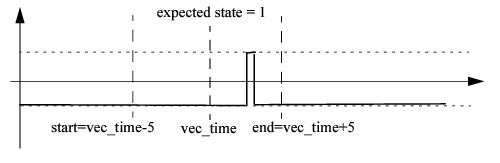
.chkwindow 5 5 0
The .chkwindow statement is set to 0, so the waveform passes the vector check (see Figure 12-1 ).
Figure 12-1 Vector Check with .chkwindow Set to 0
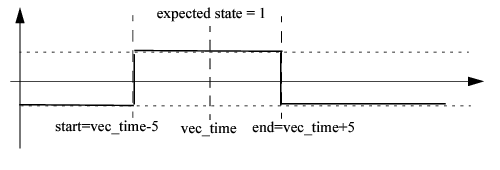
.chkwindow 5 5 1
The .chkwindow is statement set to 1 and the signal remains at that state for the entire window period, in order to pass the vector check (see Figure 12-2 ). If the signal matches Figure 12-1 , the vector check fails.
Figure 12-2 Vector Check with .chkwindow Set to 1
.chkwindow 5 5 1 period=100 first=20 p[*] out_*
tells the simulator to activate periodic window checking for signals p[*] and out_*. The vector check points start at 2 ns and repeats every 10 ns.
.chkwindow 5 5 1 first=20 X1.Xana.p[*] X1.Xdigital.Xcore.out_*
tells the simulator to ignore the first argument because a valid period argument has not been specified. The other arguments are used in the simulation.
The signal timing characteristics (delay, rise and fall time) are defined in this section.
Note: The Virtuoso UltraSim simulator checks whether the values of the .trise and .tfall. statements are reasonable (warning message is issued when the defined value is too small or large).
The .idelay statement specifies the delay time for the corresponding input signals. If a bidirectional signal is specified, this only applies to the input stage of the bidirectional signal. The default value is 0.0, if .idelay and .tdelay are not set.
All input signals have a time delay of 5 ns.
.tdelay 0.1 Xtop.XI1.a* Xtop.XI1.b
The Xtop.XI1.a[0:3] and Xtop.XI1.b input signals have a delay time of 10 ps.
The .odelay statement specifies the delay time for the corresponding output signals. If a bidirectional signal is specified, this only applies to the output stage of the bidirectional signal. The default value is 0.0, if .odelay and .tdelay are not set.
All output signals have a time delay of 5 ns.
The .tdelay statement specifies the delay time for the corresponding input, output, and bidirectional signals. The default value is 0.0, if .tdelay, .idelay, and .odelay are not specified.
All signals have a time delay of 5 ns.
The .tfall statement specifies the fall time of the input signal. If .tfall is not specified, the default value is 0.1 n.
Note: The range of voltage level change for time_value is 0-100%.
all input signals have a fall time of 0.1 ns.
input signals a[0:3] and b have a fall time of 0.1 ns.
The .trise statement specifies the rise time of the input signal. If .trise is not specified, the default value is 0.1 n.
Note: The range of voltage level change for time_value is 0-100%.
all input signals have a rise time of 0.1 ns.
input signals a[0:3] and b have a rise time of 0.1 ns.
The .vih statement specifies the logic high voltage of the input signal. If .vih is not specified, the default voltage is 3.3.
tells the Virtuoso UltraSim simulator all input signals have a logic high voltage of 5.0.
tells the simulator input signals a[0:3] and b have a logic high voltage of 5.0.
The .vil statement specifies the logic low voltage of the input signal. If .vil is not specified, the default voltage is 0.0.
tells the Virtuoso UltraSim simulator all input signals have a logic low voltage of 1.0.
tells the simulator input signals a[0:3] and b have a logic low voltage of 1.0.
The .voh statement specifies the logic high voltage of signals defined as outputs and signals from the analog netlist file that are used in the signal information file. If .voh is not specified, the default voltage is 3.3.
tells the Virtuoso UltraSim simulator all output signals have a logic high voltage of 5.0.
tells the simulator output signals out[0:3] and outA have a logic high voltage of 5.0.
The .vol statement specifies the logic low voltage of signals defined as outputs and signals from the analog netlist file that are used in the signal information file. If .vol is not specified, the default voltage is 0.0.
tells the Virtuoso UltraSim simulator all output signals have a logic low voltage of 1.0.
tells the simulator output signals out[*] and outA have a logic low voltage of 1.0.
The .outz statement specifies the output resistance for corresponding input signals. If .outz is not specified, the default value is 0.01.
All input signals have an output resistance of 1 Megaohm.
The .triz statement specifies the output impedance when the corresponding input signals are in tri-state. If .triz is not specified, the default value is 1,000 Meg.
All input signals have an output impedance of 500 Megaohms.
Hierarchical signal name mapping can be used to precisely match signals between the VCD and analog netlist files, and is defined by the Virtuoso UltraSim simulator hier statement:
The .hier statement is used to specify hierarchical names in both the VCD and analog netlist files.
|
If hier=0, the Virtuoso UltraSim simulator creates flat mapping between the VCD and analog netlist files (default). To maintain backward compatibility, the hierarchical delimiter is regarded as part of the signal name. If hier=1, the simulator applies the hierarchical names to the VCD and analog netlist files. The VCD file stimuli are no longer limited to the top level of the analog netlist file. In the VCD info file, the complete hierarchical structure needs to be added to the .scope statement (the hierarchical signals in the analog netlist file are mapped according to the information provided by the .alias statement). |
The key differences between flat and hierarchical mapping include:
|
|
To match hierarchical signals in the VCD file, the complete hierarchical structure needs to be specified in the .scope, .alias, and .chkwindow statements, as well as in the signal characteristic statements. For flat mapping, only the signal names are needed. |
|
|
For hierarchical signal name mapping, the statements to define the port direction of the signal are related to the .scope statement, which includes the .in, .out, and .bi statements. When using flat mapping, the multiple scopes defined by the .scope statement are regarded as set. The Virtuoso UltraSim simulator searches all of the scopes to perform a signal match and outputs an error message when the same signal name is defined in more than one VCD scope. |
|
|
The hierarchical structure of the analog netlist file is specified by the .alias statement when performing hierarchical mapping. |
When using the Virtuoso UltraSim simulator to apply hierarchical names to the VCD/EVCD and analog netlist files (.hier 1), the hierarchical structure in the VCD/EVCD file must be clearly defined with the .scope statement. The .in, .out, and .bi statements are used to define the signal name in the specified .scope statement and cannot contain the hierarchical structure. For the .bi statement, the enable signal needs to contain the hierarchical path because the signal may belong to a different scope.
The VCD/EVCD signal info file supports multiple .scope statements. The effective scope of each .scope statement is affected by the other statements, requiring the .in, .out, and .bi statements to be in the correct location.
* The effective scope is top.digital
* The scope top.digital is ended by the next .scope statement
* The effective scope is changed to top.digital.drv
The hierarchical structures that are defined in the .scope statement are used only for the VCD/EVCD file, so the .alias statement is needed to map the signals to the lower circuit levels of the analog netlist file.
Note: If multiple .alias statements define the mapping relationship for a signal, the last .alias statement is used by the simulator, and the other statements are overwritten.
|
Specifies the hierarchical signal names (VCD/EVCD format) that are already defined in the .scope statement and .in/.out/.bi statements. The hierarchical delimiter is represented by a period (.). |
|
|
Specifies the hierarchical signal names of the analog netlist file. The hier_delimiter option defines the hierarchical delimiter. |
tells the Virtuoso UltraSim simulator to map the TOP.module1.in1 defined in the .scope and .in/.out/.bi statements to the signal in1 of instance X1 in the analog netlist file.
.alias Top.module1.sig_*[*] X1.vec_*<*>
tells the simulator for the Top.module1.sig_[0:15] signals, the second .alias statement overwrites the first .alias statement and maps the signals to X1.vec_<0>, ... X1.vec_<15>. Since only the first .alias statement matches the digital_block.datain[*] signals, they are mapped to digital_block.datain<*> of the analog netlist file.
.usim_opt hier_limiter = %
.alias TOP.module1.sig_[*] X1%Xdrv%vec_<*>
.scope Top.module1
.out sig_*
Note: The hierarchical delimiter for the analog netlist file is percent (%), not period (.).
For hierarchical mapping, the signal names in the .alias and .chkwindow statements, as well as in the signal characteristic statements, must have the hierarchical structure in the VCD file.
.vol 0.2 X1.dout1 Xdig.X2.dout1
.tfall 0.2 Xana.X1.in* Xdig.din*
EVCD signal strength can be defined by eight values, ranging from 0 (weakest) to 7 (strongest). The most commonly used values are 0 and 6. For example, for logic value 0
<0_strength_component> =6 , <1_strength_component> =0
<0_strength_component> =0 , <1_strength_component> =6
Note: Logic strength levels are not defined in VCD files because only four states are supported.
The Virtuoso UltraSim simulator ignores strength information (minimal impact on most CMOS circuit designs). If you want to preserve driver strength during simulation, specify .outz in the signal information file for specific signals with different output resistances.
For more information about logic strength modeling, refer to IEEE Std 1364-2001.
The EVCD data command is different from the one used with VCD because the EVCD version can provide strength information and additional signal states.
|
Key character that indicates a port. Note: There is no space between p and port_value. |
|
|
State character which contains information about driving direction and the value of the port. The state characters are described in "Port Direction and Value Mapping" (see tables). |
|
|
One of the eight Verilog strength values indicating the strength0 component of the value (the Virtuoso UltraSim simulator ignores this value). |
|
|
One of the eight Verilog strength values indicating the strength1 component of the value (the Virtuoso UltraSim simulator ignores this value). |
|
|
The identifier code for the port, which is defined in the $var construct for the port. |
tells the Virtuoso UltraSim simulator the one bit bus with identifier <0 (defined by $var) has a binary value of U, and the strength of 0 component is 0 and the strength of 1 component is 7.
tells the simulator the bus with identifier ! (defined by $var) has a binary value of CCC, and the strength of 0 component is 667 and the strength of 1 component is 667. There is more than one driver on this port and the resolved value is CCC.
The port value in the EVCD file contains port direction information, which helps the Virtuoso UltraSim simulator distinguish some of the x states, apply stimuli for input signals, or perform a vector check for output signals.
Given an DUT and a test fixture, the driving direction is input if the text fixture drivers are driving a non-tristate value and the drivers inside the DUT are tri-state. The resolved value is mapped in Table 12-6.
When reading the mapping information in the following tables, it is important to note:
|
|
Declared in and declared out indicates the signal is defined as input and output in the signal information file. The term active implies the drivers are in a non-tristate condition. |
|
|
Because the conflicting states of the signal value are converted to x in the VCD file, they are regarded as "not needed" and the Virtuoso UltraSim simulator does not perform a vector check when the signals are specified as output. |
|
|
Combining the port direction for the signal value in the EVCD file and the specified direction in the signal information file, the Virtuoso UltraSim simulator can distinguish the input and output values of a signal and perform a vector check when it is specified as output in the signal information file. |
|
Declared in |
Declared out |
Declared bi |
Declared bi |
||
|
0 input |
0 input |
Low - only one active driver to the port |
|||
|
0 input |
0 input |
Low - two or more active drivers to the port (may be conflicts, yet resolved value is low) |
|||
|
1 input |
1 input |
||||
|
1 input |
1 input |
High - two or more active drivers to the port (may be conflicts, yet resolved value is high) |
|||
|
x input |
x input |
||||
|
x input |
x input |
||||
|
z input |
z input |
The driving direction is output if the driving value from drivers inside the DUT is non-tristate, but the value driven by the drivers in the test fixture is tri-state. The resolved value is mapped in Table 12-7.
|
Declared in |
Declared out |
Declared bi |
Declared bi |
||
|
z input |
Check 0 |
z input |
Check 0 |
Low - only one active driver to the port |
|
|
z input |
Check 0 |
z input |
Check 0 |
Low - two or more active drivers to the port (may be conflicts, yet resolved value is low) |
|
|
z input |
Check 1 |
z input |
Check 1 |
||
|
z input |
Check 1 |
z input |
Check 1 |
High - two or more active drivers to the port (may be conflicts, yet resolved value is high) |
|
|
z input |
z input |
||||
|
z input |
z input |
The driving direction is unknown if both the drivers in the test fixture and DUT are driving a non-tristate value. The resolved value is mapped in Table 12-8.
|
Declared in |
Declared out |
Declared bi |
Declared bi |
||
|
0 input |
Check 0 |
0 input |
Check 0 |
Low (input=0 and output=0) |
|
|
1 input |
Check 1 |
1 input |
High (input=1 and output=1) |
||
|
x input |
x input |
x (input=x and output=x) |
|||
|
0 input |
Check 1 |
0 input |
Check 1 |
x (input=0 and output=1) |
|
|
0 input |
0 input |
x (input=0 and output=x) |
|||
|
1 input |
Check 0 |
1 input |
Check 0 |
x (input=1 and output=0) |
|
|
1 input |
1 input |
x (input=1 and output=x) |
|||
|
x input |
Check 0 |
x input |
Check 0 |
x (input=x and output=0) |
|
|
x input |
Check 1 |
x input |
Check 1 |
x (input=x and output=1) |
|
|
F, f |
z input |
z input |
Tri-state (input=z and output=z) |
The following is an example of EVCD file format.
The waveform format is defined by the wf_format option in the analog netlist file. A maximum of two waveform files are generated for one or more VCD or EVCD files. The expected waveform filename is netlist.vecexp.trn (PSF, FSDB, etc.) and the output vector is signal_name_exp. The comparison waveform filename is netlist.vecerr.trn (PSF, FSDB, etc.) and each comparison waveform is signal_name_err.
The comparison result values include,
0 - matched
1 - mismatched
X - ignored (output vector = X or bi-directional vector at input stage are possible causes)
In addition to the individual comparison result waveforms, the simulator generates a single vec_error waveform to indicate the overall comparison results. Waveform vec_error equals 1 when any of the individual comparison result waveforms also have a value of 1 (X is treated as 0).
You can adjust the signal information file to match signals in the VCD/EVCD file with those in the netlist file, and leave the VCD/EVCD file unchanged. The Virtuoso UltraSim simulator only needs the scopes specified in the .scope statement and ignores the other scopes (the simulator also ignores the parent or child scope of the specified scope). The .alias statement can be used to map the signal names between the VCD/EVCD and circuit netlist files.
As digital vector format, first probe the signals in the top-level using .probe tran v(*) depth=1 and check the waveform outputs with the Virtuoso Visualization and Analysis or SimVision viewers.
Note: The signal names are case sensitive.
A netlist.veclog file is generated at the location specified by the Virtuoso UltraSim simulator option-raw statement if there are any vector checks. A netlist.vecerr file is also generated when errors occur during the vector check. Refer to these two files for detailed information about the vector check.
Flat signal name mapping works for most situations, but suffers from the following limitations:
|
|
When multiple .scope statements are used in a digital VCD file, the Virtuoso UltraSim simulator treats them as a single set and searches for signals (as defined in the .in, .out, and .bi statements) in all of the .scope statements. An error occurs when a signal with the same name appears in more than one .scope statement. |
Hierarchical signal name mapping is able to overcome these limitations, allowing you to map signals to the lower levels of the analog netlist file and to use multiple .scope statements (see "Enhanced Statements" for more information about .scope statements).
|
|
CPU time is the time the central processing unit (CPU) spends running the user program |
|
|
User time is the user and system times combined (that is, the total time needed to provide system service to the user program) |
Note: The elapsed user time can be less than the elapsed CPU time.