
10
HBT Model (version 2)
The Cadence HBT (Hetero-junction Bipolar Transistor) element implements the HBT model, developed by University of California San Diego (UCSD) as part of the ARPA High Speed Circuit Design Program. The UCSD HBT model, like the Berkeley BSIM3 model, was conceived as an industry standard SPICE model. This model may be described as a revised version of the standard Gummel-Poon model, where some portions of the model have been enhanced or modified to support features not supported by the original Gummel-Poon model, while the remaining has been kept unchanged. Support for breakdown and self-heating are among the most important new features introduced by this model. The Cadence HBT model is fully compatible with the AWR HBT model.
The following diagram shows the symbol of this model.
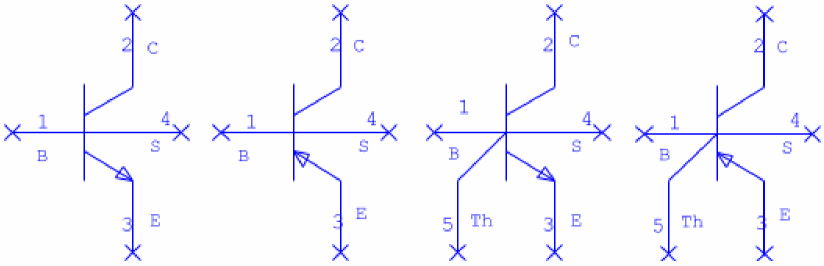
Since this model supports both the UCSD original model and AWR extensions, the model has an extensive parameter set. Some parameters are shared by both modes of operation and some are exclusive to a particular one. The AWR extensions are enabled by choosing the appropriate setting of the ext_flag parameter. The selft parameter controls whether self-heating simulation is supported or not. The self-heating terminal is shown or hidden, accordingly. The extraction and device temperatures are controlled using the tnom and temp parameters, respectively. The temperature parameter tbp (Temperature of the Base Plate) enables partial self-heating simulation. This type of operation is not enabled when the model supports the AWR extensions. The type parameter controls whether the device is NPN or PNP.
selft parameter to off. This removes unused self-heating associated branches from the model, resulting in faster execution time. The dtmax parameter limits the value of self-heating induced temperature changes during simulation. You should keep this value as small as possible, provided it does not affect the simulation results. Return to top