
Core Model
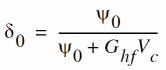
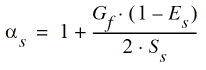
Lateral Gradient Factor
The lateral field gradient in SPMOS is reduced with surface potential through the following semi-empirical formula:
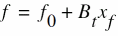


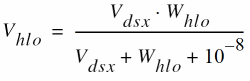
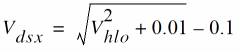

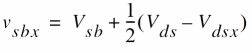


Effective Drain-Source Voltage
The saturation voltage is given by

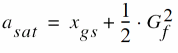
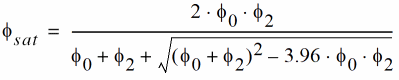
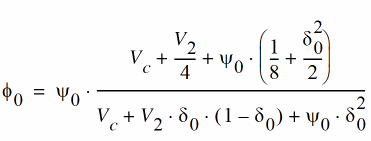
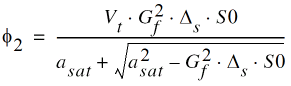
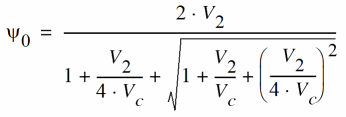
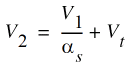
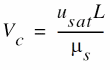
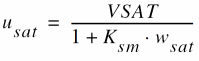
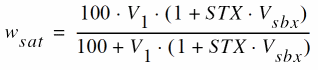
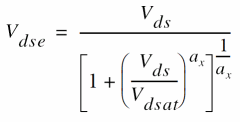
The effective drain-source voltage is given by
Surface Potential
Surface Potential at Source End of Channel
The approximate analytical solution for surface potential is
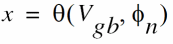
where the normalized imref splitting is
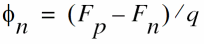
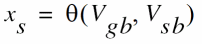
In the process of computing surface potential, the following are computed as well
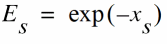
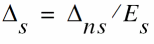

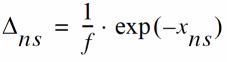

The evaluation of  ,
, ,
, is carefully ordered to avoid over/underflow problems.
After evaluating surface potential , you can compute the normalized inversion charge at the source
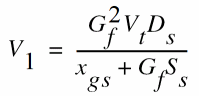
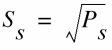
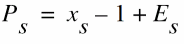
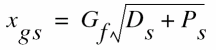
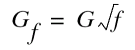
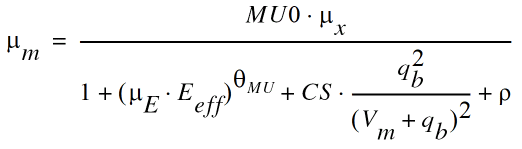
Series resistance is given by:
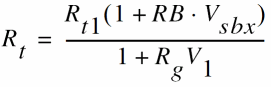
Series resistance factor is given by:

Effective vertical field is given by:

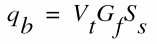
where 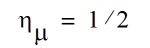 for n-channel and
 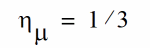 for p-channel MOSFETs.
Effective mobility at the source end of the channel is given by:
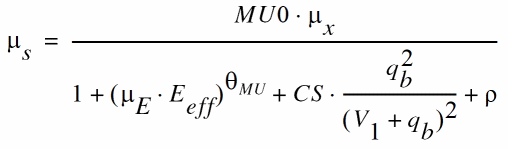

where the term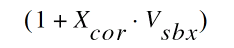 introduces non-universality. The denominator assures that
  does not exceed 5 for extreme (and unphysical)
 .
.
 and
and  are temporary variables. Eventually these will be changed to assure the symmetry of the model. Also,
  if external model of series resistance is used.
Surface Potential at Drain End of Channel
Surface potential at the drain end of the channel is
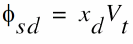

The above equation is used when

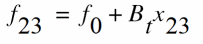
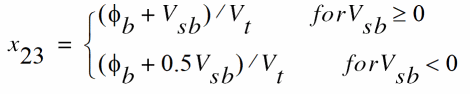
For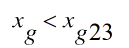 , it is more efficient to:

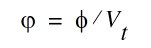
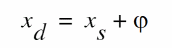 .
.
While computing  , the following variables are computed as well:
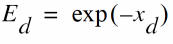

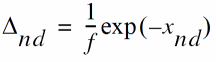

Mid-Point Surface Potential
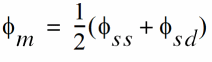
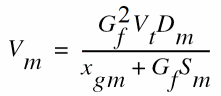
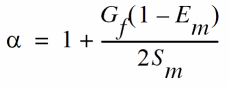
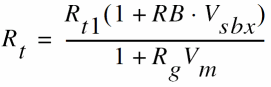
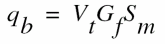
The following variables are used:
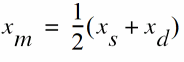
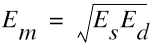
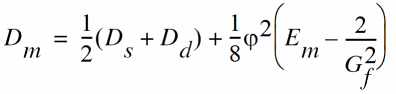
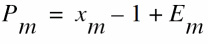
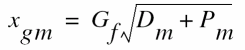
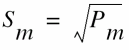
Normalized inversion charge is calculated by:


where 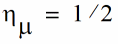 for n-channel and
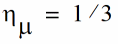 for p-channel MOSFETs.
Quantum Mechanical Corrections
In SPMOS quantum-mechanical (QM) corrections are considered in the most common case  which is of interest for the charge-sheet models.
QM corrections are directly used for 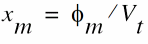 and
and 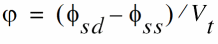 .
.
This is preferable to correcting  and
and  , especially in the case when
  is a small difference of two large variables.
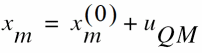
In the following equations, superscript 0 refers to variables uncorrected for QM effects.
 (i.e. for
 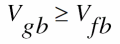 )
)
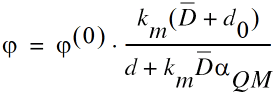
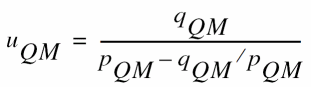
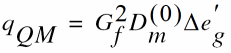
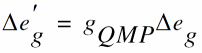
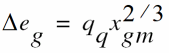
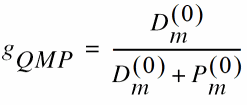

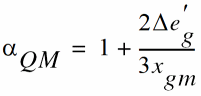

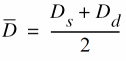


 ,
,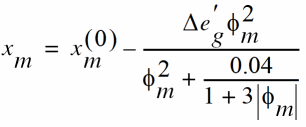
There is no correction for  . This form is introduced to eliminate the singularity or unphysical behavior near
 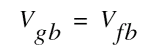 . Coefficients 0.04 and 3 are not affected by model parameters and are fixed.
In addition to correcting  and
and  , QM effects are introduced into
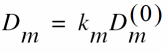
and variables 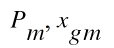 , which are given by the above expressions but with
  corrected for QM effects.
Polysilicon Depletion
In SPMOS polysilicon depletion equations are conditioned to provide smooth device characteristics for a wide voltage range but at present the poly effects are only included for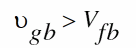 .
.
The normalized poly surface potential at midpoint
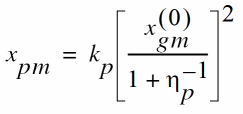
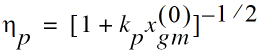
In this section the superscript 0 indicates that the variable is not corrected for poly depletion effect.
Poly corrections are introduced into 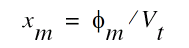 and
and  rather than into
  and
and  directly.
The corrected midpoint surface potential is
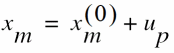
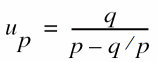

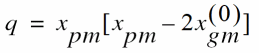
The correction to normalized surface potential difference  is as follows
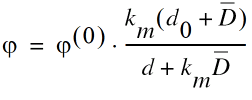
where  is given in section “Quantum Mechanical Corrections” with superscript 0 indicating that the variable is not corrected for poly depletion effect

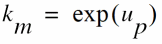
In addition to changing the surface potentials, poly correction affects the linearization of inversion charge and intrinsic charges. The expressions in sections “Drain Current” and “Intrinsic Charges” include these corrections.
The case of no poly effect can be recovered by setting 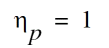 . While physically this corresponds to
 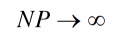 , in SPMOS eliminating poly effects is formally prescribed by setting
 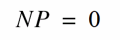 in the parameter file.
Drain Current
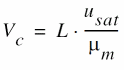
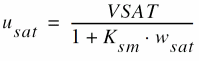
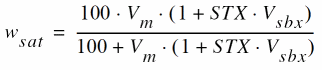
This ensures that 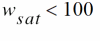 and
and 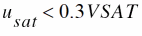 during SPICE convergence when
  can be unphysically high.
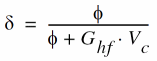
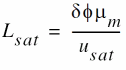
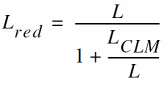
The channel length modulation factor is calculated by the following equation:

Drain current is calculated by
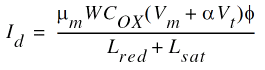
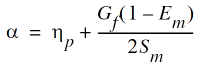
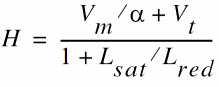
where the inversion charge linearization (including polysilicon depletion effect) is:
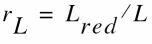
Intrinsic Charges
All charges are normalized to  .
.




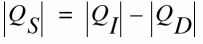
Drain charge (computed using Ward-Dutton partition)

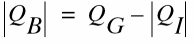
Bias-Dependent Body Factor
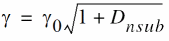


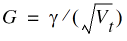
Return to top