
Model Equations
Equivalent Circuit
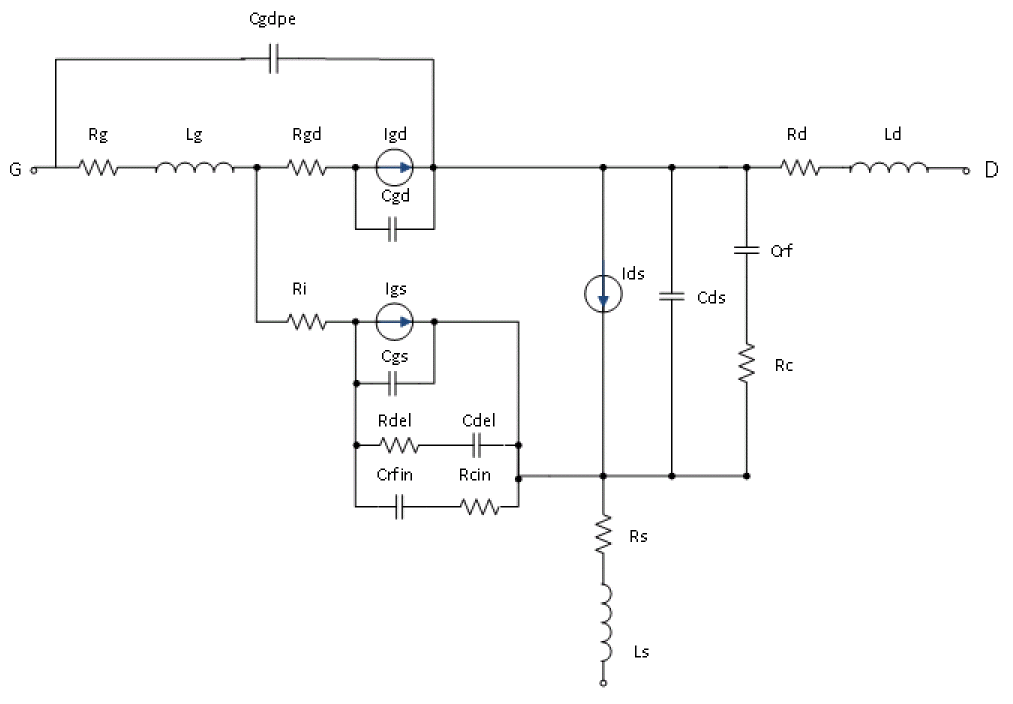
Ids Equations





For the symmetric model (idsmod=1)






















Igs and Igd Equations






Temperature Equations







Charge Equations




Cgs = CGSP
Cgd = CGDP
Qgs = CGSP * Vgsc
Qgd = CGDP * Vgdc
Cgs = CGSP+CGS0 x ( 1 + tanh(Phi1))( 1 + tanh(Phi2))
Cgd = CGDP + CGD0 x ((1 - P111 + tanh(Phi3)) (1 + tanh(Phi4)) + 2 x P111)
Qgs = CGSP x Vgsc
Qgd = CGDP x Vgdc
Lc1 = ln(cosh(Phi1))
Lc10 = ln(cosh(P10 + P11 X Vds))
Qgs = CGSP x Vgsc + CGS0 x ((Phi1 + Lc1 - Qgs0) x (1 + tanh(Phi2)) / P11 + 2 x P111 x Vgsc
Qgs0 = P10 + P111 x Vds + Lc10
Lc4 = 1n(cosh(Phi4))
Lc40 = 1n(cosh(P40 -P111 x Vds))
Qgd = CGDP x Vgdc + CGD0 x ((Phi4 + Lc4 - Qgd0) x (1 - P111 + tanh(Phi3)) / P41 + 2 x P111 x Vgdc
Qgd0 = P40 - P111 x Vds + Lc40
y = (((Vgsc+2.0)/P10) - 1.0)
Cgsdep1 = pow((m + (y x y)), -1.5) x m
tanh1 = 1 + tanh(P10 + P11 x (Vgsc + P111 x Vds))
tanh2 = (1 + tanh(P20 + P21 x Vds))
tanh3 = 1 - P111 + tanh(P30 + P31 x Vds)
tanh4 = 1+ tanh(P40 + P41 x (Vgdc + Vds x (1 - P111)))
Cgs = CGS0 x (tanh1 + P222 x Cgsdep1) x tanh2 + CGSP
Cgd = CGD0 x (tanh3 x tanh4 + 2 x P111) + CGDP
Qgs = Cgs x Vgsc
Qgd = Cgd x Vgdc
Lc1 = ln(cosh(Phi1))
LC10 = ln(cosh(P10 +P111 x Vds)
Qgsdepl = P222 x (P10 + Vgsc) x pow(m + pow(-1 + (Vgsc/P10),2), -0.5)
Qgsdep10 = P222 x P10 x pw((m+1), -0.5)
Qgs0 = P10 + P111xVds + Lc10
Qgs = CGS0 x ((Phi1 + Lc1 - Qgs0 + Qgsdep1 - Qgsdep10) x (1 - P111 + tanh(Phi2))/P11 + 2 x P111 x Vgsc) + CGSP x Vgsc
Lc4 = ln(cosh(Phi4))
Lc40 = ln(cosh(P40 - P111 x Vds)
Qgd0 = P40 - p111 x Vds + Lc40
Qgd = Cgd0 x ((Phi4 + Lc4 - Qgd0) x (1 - P111 + tanh(Phi3))/P41 + 2 x P111 x Vgdc) + CGDP x Vgdc
Excess Phase
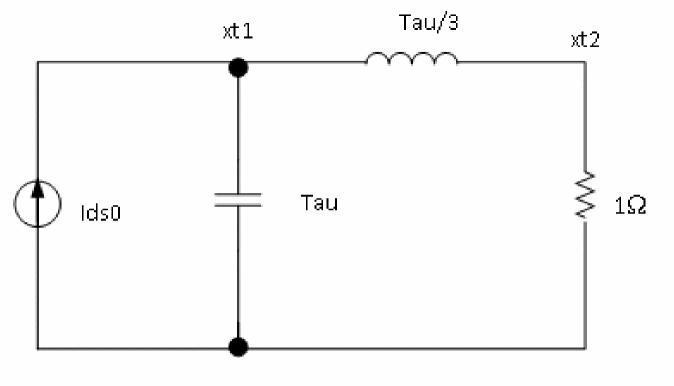
In an actual device, the measured phase shift is often larger than the shift predicted by the lumped model. The excess-phase parameter td accounts for this extra phase shift at high frequencies. An all-pass, second-order Bessel function filter creates this extra phase shift. The frequency response of this filter is:


The Bessel filter is implemented with the excess phase network, as shown in the figure below.
Self Heating Model
The power used for the self-heating model is given by:

Noise Model
Broadband Noise:



Parameters NoiseP, NoiseR, and NoiseC model the drain and gate noise sources, and their correlation.



Igs, Igd Shot Noise and Flicker Noise


Ids Flicker Noise



Thermal Noise
Thermal noise of resistances Rgd, Rd, Rg, and Rs


Related Topics
Return to top