
1
Modeling Concepts
This chapter introduces some important concepts basic to using the Cadence® Verilog®-AMS language, including
Verilog-AMS Language Overview
The Verilog®-AMS language lets you create and use modules that describe both the high-level behavior and the structure of analog and mixed-signal systems and components. You describe the behavior of a component mathematically in terms of its ports and external parameters. You describe the structure of a component in terms of interconnected subcomponents. With the statements of Verilog-AMS, you can describe a wide range of systems, such as electrical, mechanical, fluid dynamic, and thermodynamic systems.
For analog aspects of the design, the simulator uses Kirchhoff’s Potential and Flow laws to develop a set of descriptive equations and then solves the equations with the Newton-Raphson method. See Appendix A, “Nodal Analysis,” for additional information.
For information about the digital capabilities of Verilog-AMS, see the NC Verilog Simulator Help, the Verilog-XL Reference, and the IEEE Standard Hardware Description Language Based on the Verilog Hardware Description Language.
To introduce the algorithms underlying system simulation, the following sections describe
- What a system is
- How you specify the structure and behavior of a system
- How the simulator develops a set of equations and solves them to simulate a system
Describing a System
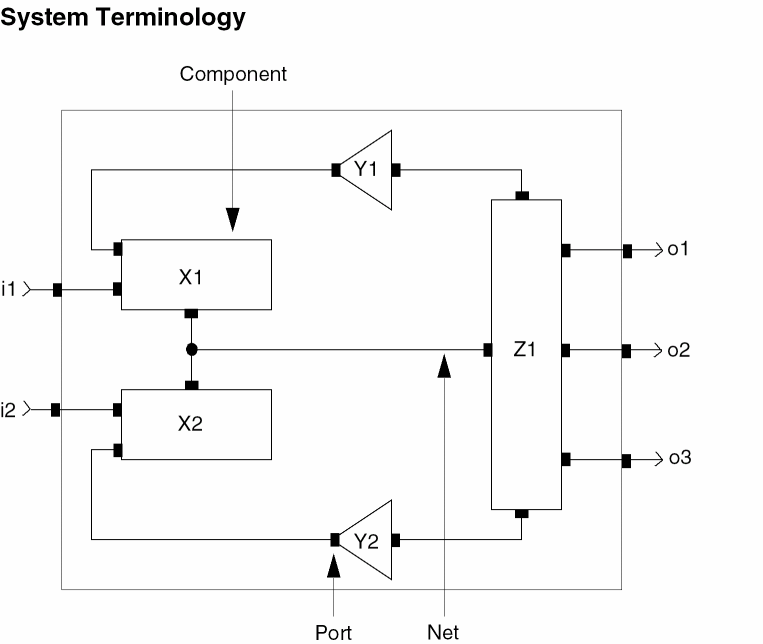
A system is a collection of interconnected components that produces a response when acted upon by a stimulus. A hierarchical system is a system in which the components are also systems. A leaf component is a component that has no subcomponents. Each leaf component connects to zero or more nets. Each net connects to a signal which can traverse multiple levels of the hierarchy. The behavior of each component is defined in terms of the values of the nets to which it connects.
A signal is a hierarchical collection of nets which, because of port connections, are contiguous. If all the nets that make up a signal are in the discrete domain, the signal is a digital signal. If all the nets that make up a signal are in the continuous domain, the signal is an analog signal. A signal that consists of nets from both domains is called a mixed signal.
Similarly, a port whose connections are both analog is an analog port, a port whose connections are both digital is a digital port, and a port with one analog connection and one digital connection is a mixed port. The components interconnect through ports and nets to build a hierarchy, as illustrated in the following figure.
Analog Systems
The information in the following sections applies to analog systems.
Nodes
A node is a point of physical connection between nets of continuous-time descriptions. Nodes obey conservation-law semantics.
Conservative Systems
A conservative system is one that obeys the laws of conservation described by Kirchhoff’s Potential and Flow laws. For additional information about these laws, see “Kirchhoff’s Laws”.
In a conservative system, each node has two values associated with it: the potential of the node and the flow out of the node. Each branch in a conservative system also has two associated values: the potential across the branch and the flow through the branch.
Reference Nodes
The potential of a single node is defined with respect to a reference node. The reference node, called ground in electrical systems, has a potential of zero. Any net of continuous discipline can be declared to be ground, and in this case, the node associated with the net is the global reference node in the circuit. For information about declaring a ground, see “Ground Nodes”.
Reference Directions
Each branch has a reference direction for the potential and flow. For example, consider the following schematic. With the reference direction shown, the potential in this schematic is positive whenever the potential of the terminal marked with a plus sign is larger than the potential of the terminal marked with a minus sign.

Verilog-AMS uses associated reference directions. Consequently, a positive flow is defined as one that enters the branch through the terminal marked with the plus sign and exits through the terminal marked with the minus sign.
Signal-Flow Systems
Unlike conservative systems, signal-flow systems associate only a single value with each node. Verilog-AMS supports signal-flow modeling.
Mixed Conservative and Signal-Flow Systems
With Verilog-AMS, you can model systems that contain a mixture of conservative nodes and signal-flow nodes. Verilog-AMS accommodates this mixing with semantics that can be used for both kinds of nodes. With Verilog-AMS you can model systems containing digital domain information too, so you can mix conservative analog, signal flow analog, and digital modeling in one mixed-signal system.
Simulator Flow for Analog Systems
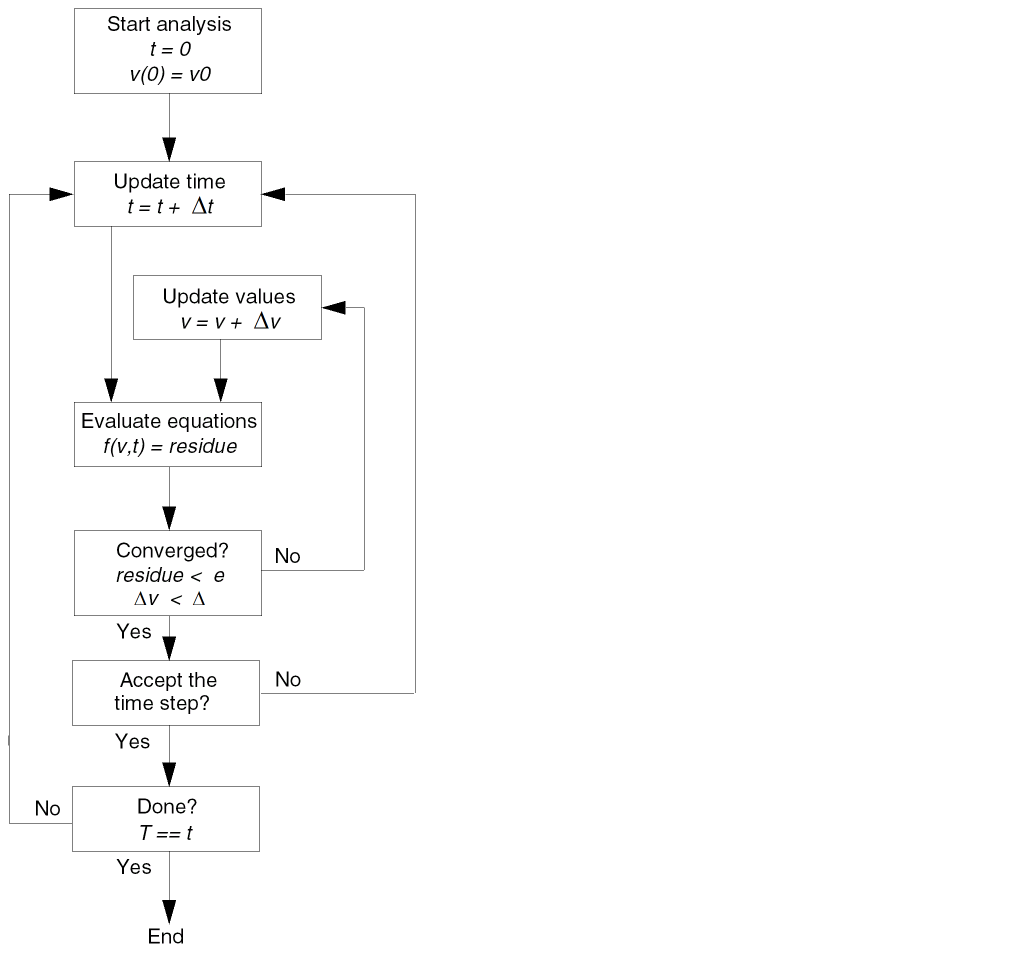
After you specify the structure and behavior of a system, you submit the description to the simulator. For analog systems, the simulator then uses Kirchhoff’s laws to develop equations that define the values and flows in the system. Because the equations are differential and nonlinear, the simulator does not solve them directly. Instead, the simulator uses an approximation and solves the equations iteratively at individual time points. The simulator controls the interval between the time points to ensure the accuracy of the approximation.
At each time point, iteration continues until two convergence criteria are satisfied. The first criterion requires that the approximate solution on this iteration be close to the accepted solution on the previous iteration. The second criterion requires that Kirchhoff’s Flow Law be adequately satisfied. To indicate the required accuracy for these criteria, you specify tolerances. For a graphical representation of the analog iteration process, see the Simulator Flow for Analog Systems figure. For more details about how the simulator uses Kirchhoff’s laws, see “Simulating an Analog System”.
Return to top