
Structure of PSP102
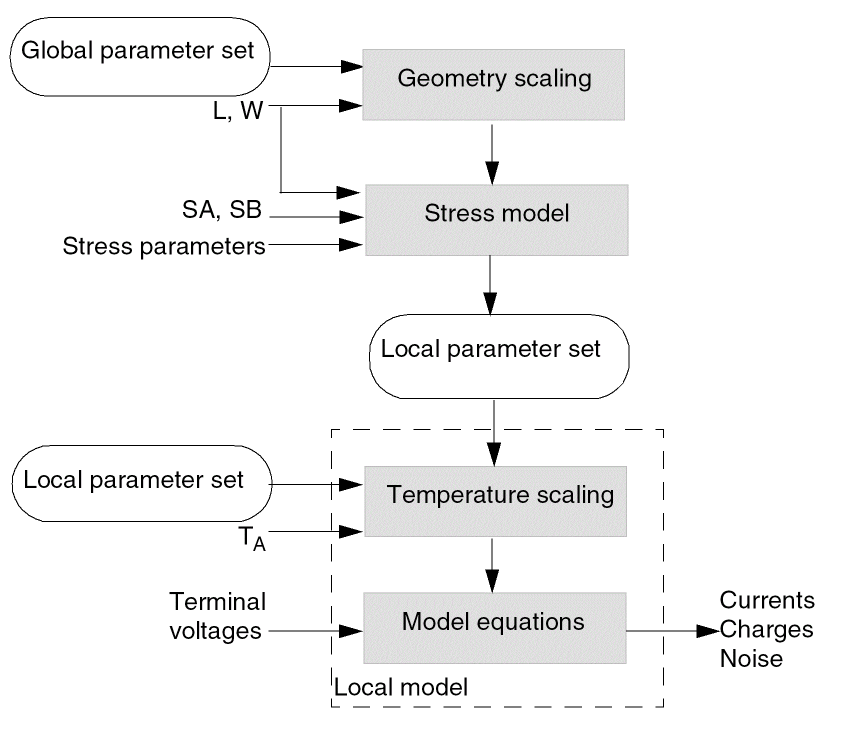
The PSP model has a hierarchical structure, similar to that of MOS Model 11 and SP. This means that there is a strict separation of the geometry scaling in the global model and the model equations in the local model.
As a consequence, PSP can be used at either one of two levels.
- Global level One uses a global parameter set, which describes a whole geometry range. Combined with instance parameters (such as L and W), a local parameter set is internally generated and further processed at the local level in the same way as a custom-made local parameter set.
- Local level One uses a custom-made local parameter set to simulate a transistor with a specific geometry. Temperature scaling is included at this level.
The set of parameters which occur in the equations for the various electrical quantities is called the local parameter set. In PSP, temperature scaling parameters are included in the local parameter set. Each of these parameters can be determined by purely electrical measurements. As a consequence, a local parameter set gives a complete description of the electrical properties of a device of one particular geometry.
Since most of these parameters scale with geometry, all transistors of a particular process can be described by a (larger) set of parameters, called the global parameter set. This set contains all local parameters for a long/wide device plus a number of sensitivity coefficients. From the global parameter set, you can obtain a local parameter set for a specific device by applying a set of scaling rules. For more information, see Calculation of Transistor Geometry. The geometric properties of that specific device (such as its length and width) enter these scaling rules as instance parameters.
PSP is preferably used at the global level when designing a circuit in a specific technology for which a global parameter set is available. On the other hand, using PSP at local level can be helpful during parameter extraction.
As an option, it is possible to deal with the modification of transistor properties due to stress. In PSP, this is implemented by an additional set of transformation rules, which are optionally applied to the intermediate local parameter set generated at the global level. The parameters associated with the stress model are consequently part of the global parameter set.
The model structure described above is schematically depicted in the following figure.
The JUNCAP2 model is implemented in such a way that the same set of JUNCAP2 parameters can be used at both the global and the local level.
Related Topics
Geometrical Scaling and Stress Model for Intrinsic MOSFET
Non-Quasi-Static (NQS) RF Model
Component Statements for PSP102 Models
Return to top