
Model Version Updates
Version 3.2
- Add model selector “soimod”. “soimod” will determine the operation of BSIMSOI: If soimod=0 (default), the model equation is identical to the BSIMPD equation; if soimod=1 the model equation is an unified model for PD FD; if soimod=2, the model equation is identical to the BSIMFD equation
- Implements a flicker noise and thermal noise model compatible with BSIM4 has been. In addition, the new noise model includes gate tunneling-induced shot noise and thermal noise due to gate electrode resistance.
Version 4.0
- A scalable stress effect model for process induced stress effect, device performance becoming thus a function of the active area geometry and the location of the device in the active area;
- Asymmetric current/capacitance model S/D diode and asymmetric S/D resistance;
- Improved GIDL model with BSIM4 GIDL compatibility;
-
Noise model Improvements;
- Improved width/length dependence on flicker noise
- SPICE2 thermal noise model is introduced as TNOIMOD=2 with parameter NTNOI that adjusts the magnitude of the noise density
- Body contact resistance induced thermal noise
- Thermal noise induced by the body resistance network
- Shot noises induced by Ibs and Ibd separated
- A two resistance body resistance network introduced for RF simulation;
- Threshold voltage model enhancement;
- Drain induced threshold shift (DITS) model introduced in output conductance;
- Improved model accuracy in moderate inversion region with BSIM4 compatible Vgsteff;
- Multi-finger device with instance parameter NF;
- A new instance parameter AGBCPD to improve gate current for body contact;
- A new instance parameter DELVTO representing threshold voltage variation;
- FRBODY is both instance/model parameters.
Version 4.1
- New Material Model
- New Mobility Model for High k Material
- New GIDL/GISL Model
- New Impact Ionization Current Model
- New Body Contact Model
- New DITS Model
- Improved VgsteffCV model
- Improved Built Improved Built-in Potential Lowering (?Vbi) Model
Version 4.2
- No new features are added in this version.
- Bug-fix for charge and capacitance
- Bug-fix for gate to bulk tunneling current “Igb” calculation
- Bug-fix for vgsteff derivative calculation.
Version 4.3
- No new features are added in this version.
- Bug-fix for temperature derivative calculation with selfheating.
- Bug-fix for dc swapping issue.
- Bug-fix for Abulk discontinuity issue.
- Bug-fix for vgst, vfbeff, vfbeff2, vgsteff, vgsteff 2, Qs2 and Iii derivative calculation.
- Bug-fix for missing number of finger in some calculation.
- Add source and drain edge components of Gate-source, Gate-drain diffusion tunneling currents.
- Igisl and Igidl current formulations revised for continuity and consistency.
Version 4.31
- No new features are added in this version.
- Bug-fix for new material model
- Bug-fix for missing number of finger in Ig_agbcp2 current.
- Bug-fix for Igcs/Igcd derivative calculation.
Version 4.4
- Extensive derivative fixes for SOIMOD=1 and 2 are provided
-
A new sidewall fringe capacitance model parameter
cfrcoeffis added. -
Limiting for peak channel doping concentration parameter
nchwhen soimod=2.
Version 4.5
-
Support added for correlated thermal noise at
tnoimod=3. -
dcandacDIBL parameters have been decoupled -
New model parameters
EGGBCP2,EGGDEP,AGB1,BGB1,AGB2,BGB2,AGBC2N,AGBC2P,BGBC2N,BGBC2P, andVTM00have been added. -
The source/drain conductance is now set to
1.0e3instead of 0 when the value ofNRSandNRDis 0. - Inconsistency in drain current when selfheating is on has been addressed.
-
GISL/GIDLmodel forgidlMod=0andgidlMod=1has been modified. -
In
capmod=3, XDC calculation has been modified. -
pwris now positive inwhite_noise(pwr,name)in the thermal noise model implementation. -
NTNOIandNOIFparameters are now limited to positive values only. -
Thermal noise contribution due to
rbodyhas been included. -
Calculation of
Abulkhas been updated to avoid non-monotonic behavior at high body bias. - Some bugs have been fixed.
Version 4.6.0
- Added identifying names to all noise sources.
- Support added for node collapsing difference between C code and Verilog-A code for SOIMOD=2 4.
- Binning parameter for Npeak.
-
Improved implementation of source/drain resistance when
RSH=0to speed up simulation. -
Introduced parameters for better fitting accuracy when using
MTRLMOD=0(body contacted device). - Use of Clamped log function.
- Proper units and ranges are set for parameters.
- Improved the clamped log function efficiency.
- Modified gate charge and capacitance calculations to include overlap charge.
- Binning of Built-In Potential Lowering (ÄVbi) Model Parameters.
- Output variables added for self-heating mode.
- Some bugs have been fixed.
Version 4.6.1
Special Bugfixes
Rth thermal resistance
Rth is the thermal resistance of one device and should be the total resistance of the shunt connected fingers.
Rth = Rth0 / (Weff + Wth0) * Nseg;
Rth = Rth0 / (NF* (Weff + Wth0)) * Nseg;
Cth thermal capacity
Cth is the thermal capacity of one device and should be the total resistance of the shunt connected fingers.
Cth = Cth0 * (Weff + Wth0) / Nseg;
Cth = Cth0 * (NF* (Weff + Wth0)) / Nseg;
ExpVgst bug handling
In the original BSIMSOI model, ExpVgst was multiplied by itself by a mistake when calculate the effective Vgst for charge model. To fix this issue UC Berkeley added Vgstcvmod flag in BSIMSOI 4.1
Vgstcvmod=0: keep the bug (Cadence fixed it for version > 4.0)
Vgstcvmod=1: the bug fixed in UC Berkeley code
Vgstcvmod=2: New charge model (introduced in 4.1)
It is released in MMSIM711 with BSIMSOI version 4.1. The default value of Vgstcvmod is 0.
In BSIMSOI version 4.2 released in MMSIM72, the default value of Vgstcvmod is changed to 1.
Temperature node tolerance and quantity
Spectre supports handling different node behavior and temperature node property should be different from electric node. BSIMSOI temperature node is not properly implemented in Spectre which may cause convergence issue.
It is fixed in MMSIM711_ISR6 (April, 2009)
Iii (substrate current)
Iii is the impact ionization current from channel to bulk body for one finger and should multiply with number of ginger to get the total impact ionization current. Cadence fixed it as Iii * NF
It is fixed in MMSIM72 base release with BSIMSOI version 4.2.
Bugfix control methodology
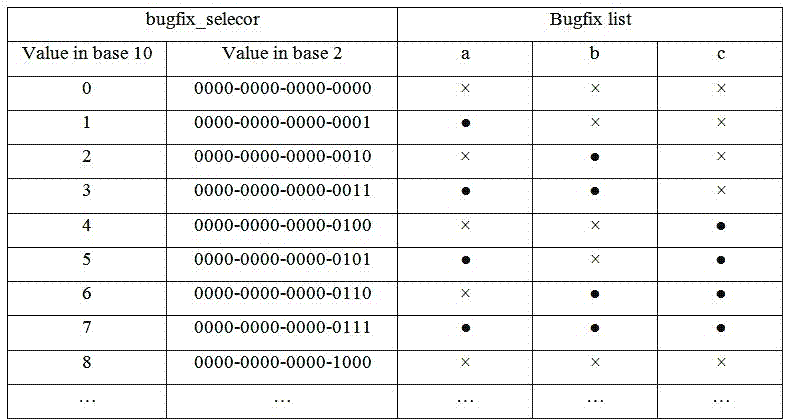
Spectre BSIMSOI model introduced a new methodology to control all bugfix Cadence did. A new model flag parameter "bugfix_selector" was add to BSIMSOI model to control the special bugfix cadence did in BSIMSOI model. It is an unsigned int. Every bit of its binary format controls one bugfix. With this methodology, every bugfix can be turned on or off independently.
Currently, there are three bugfixes are controlled:
- Bit0 for bugfix of double ExpVgst when VgstcvMod = 0. (Version != 4.01)
- Bit1 for bugfix of Vgsteff derivative when VgstcvMod = 0. (Version >= 3.2)
Bit2 for bugfix of channel thermal noise when nf > 1. (Version < 4.31)
TMI Support
Starting with the SPECTRE 17.1 release, support for the TMI model has been added in the BSIMSOI model. TMI is a modeling application programming interface (API) that supports extensions of standard compact models.
TMI provides an alternative approach to support model equations for advanced technologies in addition to adding more macro models. It provides good flexibility as macro model and good simulation efficiency as built-in standard model at the same time.
To use the TMI for the BSIMSOI model, you need to correctly set the TMI options and parameters. For more information on TMI options and parameters, refer to the TMI documentation.
Related Topics
BSIMSOI MOSFET Model (bsimsoi)
Return to top